A distracted driver who injured you in Philadelphia can be held responsible for your medical bills, lost income, vehicle damage, and, in many cases, your pain and suffering. Whether the other driver was texting, following a navigation app, or just glancing at a phone, what decides your claim is proving the distraction and tying it to your injuries.
Pennsylvania’s insurance rules, especially the full tort or limited tort choice on your own policy, shape how much you can recover, so the smartest move is to understand your options early. Call or text The Slocum Firm at (570) 209-7376 any hour of the day for a free case review and speak directly with a Philadelphia distracted driving attorney, not a call center. You owe no fee unless we win.
Did a box on your insurance policy already shrink your claim?
Pennsylvania runs a choice no-fault system, and the option you picked at signup carries more weight than almost anything else in your case. Drivers select between full tort and limited tort coverage. Full tort keeps your right to sue for pain, suffering, and the human cost of the crash.
Limited tort trades a cheaper premium for a hard restriction: you generally cannot recover those non-economic losses unless your injury clears the statutory threshold for a serious injury, defined as death, serious impairment of a body function, or permanent serious disfigurement under 75 Pa.C.S. Section 1702.
That threshold decides cases. A limited tort driver with a fractured wrist and months of therapy might collect medical bills and lost wages, yet nothing for the pain itself, while the identical crash under full tort opens the full range of damages. The line between a minor strain and a serious impairment is precisely where insurers dig in, and it is worth the fight.
Most drivers cannot even recall which option they chose, because the decision happened in a rushed signup years ago and never came up again until a wreck made it matter. We pull your declarations page early, so we know the rules of your own case before the insurer recites them back to you.
The election is not the final word, though. Limited tort drops away in several situations: when the at-fault driver was convicted of or accepted ARD for drunk driving, when that driver operated a vehicle registered out of state, or when they meant to cause harm.
One honest point most sites skip is this: distraction by itself does not automatically lift the limited tort bar the way a DUI does. That reality puts the severity of your injury and the carelessness behind the wheel at the center of the work.
How do you prove the other driver was distracted?
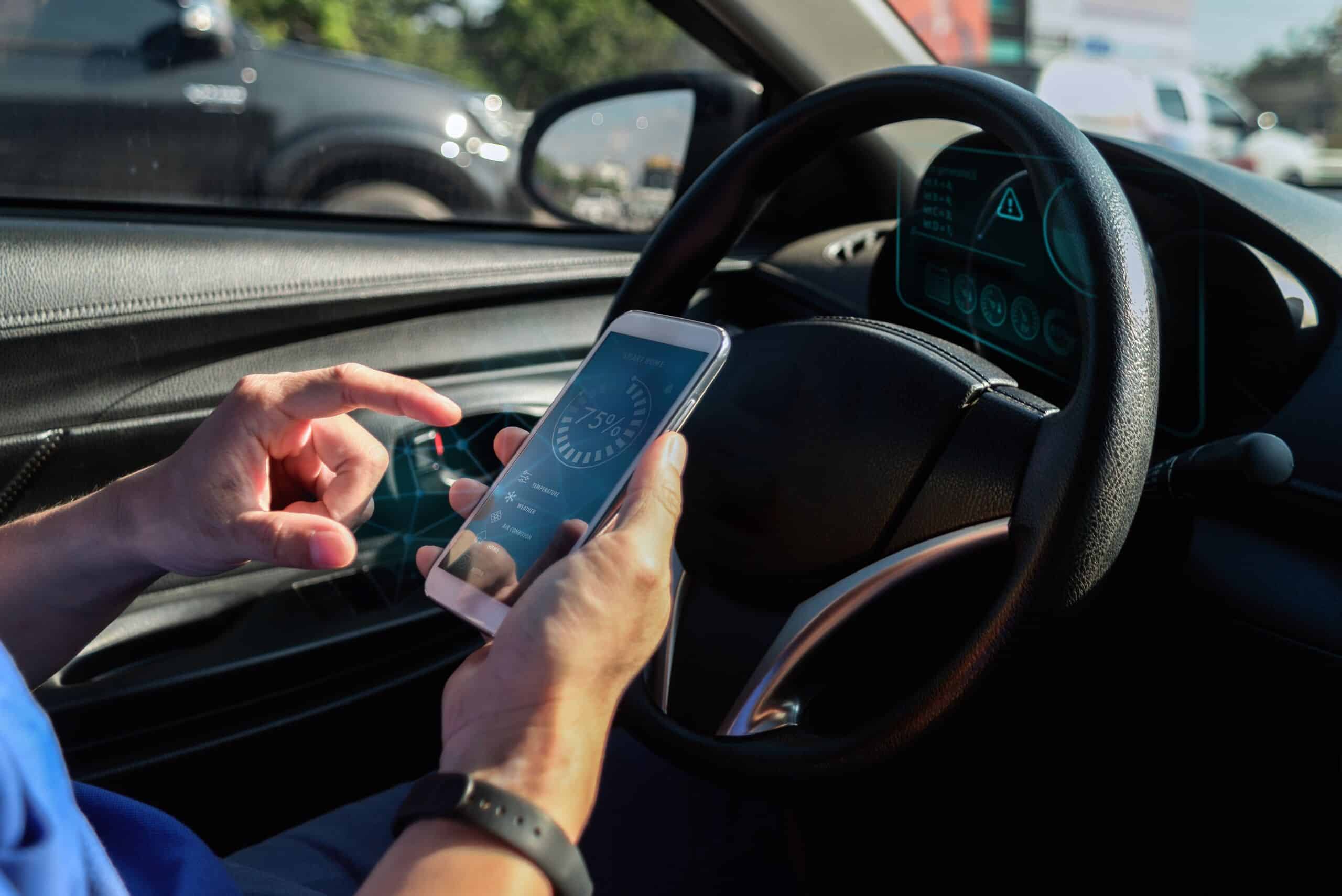
Distraction rarely announces itself. The at-fault driver almost never admits to staring at a phone, and by the time anyone asks, the account has hardened into a tidy “I just never saw them.” Proving what truly happened takes evidence with a short shelf life, which is why speed matters more in these cases than in nearly any other crash.
Cell phone records sit at the center. A targeted subpoena can surface calls, texts, and data activity timed to the second of impact, and app-level records often expose scrolling or streaming that a basic phone bill hides.
We pair those logs with the vehicle’s event data recorder, the so-called black box, which captures speed, braking, steering, and throttle in the final seconds before a collision. When the device activity and the black box line up, a supposedly unavoidable wreck often turns out to be a driver who never tapped the brakes.

We also pull dashcam and nearby business surveillance footage, canvass witnesses, while their memories stay sharp, and send preservation letters within days, before a leased or totaled vehicle gets crushed and its data vanishes for good. Unlike a routine rear-end claim, a distracted driving case lives or dies on this digital trail, and once it disappears, it does not come back.
When the conduct was reckless enough to draw criminal charges, that parallel case can shake loose evidence we use on the civil side, though our investigation never waits on a prosecutor’s timeline. Evidence in a distracted driving case disappears within days. The sooner we start, the more of it we can lock down.
Distracted driving is one of the most common reasons for crashes in the city—learn about the other leading factors by reading our guide on the common causes of auto accidents in Philadelphia.
What does Pennsylvania’s hands-free law mean for your case?
Pennsylvania now bans handheld device use behind the wheel under Paul Miller’s Law, named for a young man killed by a distracted driver. Holding a phone to talk, text, or scroll counts as a primary offense, which means an officer may stop a driver for that conduct alone, even while paused at a red light.
The measure builds on the state’s longer-standing ban on texting and driving while a vehicle is in motion.
For your claim, a violation does real work. When the at-fault driver broke a safety law written to prevent this exact harm, that breach strengthens the argument that they drove negligently. A traffic citation does not hand you the case outright, and the civil burden still rests on you to connect the distraction to your injuries.
Even so, a documented violation, paired with the phone and black-box evidence, builds a story a jury grasps without needing a law degree. The same violation raises the stakes for the at-fault driver, since prosecutors increasingly treat the hands-free law as a building block in reckless-driving and vehicular cases when distraction leads to serious injury.
Who else might be responsible besides the driver?
The distracted driver is the obvious defendant, but not always the only one, and sometimes not the one with enough insurance to make you whole. When the at-fault driver was working at the time, delivering food, hauling freight, or driving for a rideshare app, their employer may share legal responsibility for the crash.
Commercial and rideshare policies often carry far higher limits than a personal auto policy, which can be the difference between a settlement that covers your future care and one that runs dry halfway through treatment.
Rideshare crashes follow their own rules. When an Uber or Lyft driver is logged in and carrying a passenger, a large company policy generally applies, while a driver waiting between fares may fall under much thinner coverage.

Sorting out which policy was live at the moment of impact takes early investigation that a quick insurance call will not give you. The company will not flag a driver’s status for you, so we move fast to lock down trip logs and dispatch records before they get purged.
If the distracted driver carried little or no insurance, your own uninsured and underinsured motorist coverage may step in to pay. Many people forget they carry it, and insurers rarely volunteer the reminder.
A fair recovery should account for far more than your first hospital bill: the care still ahead, the wages you lost, the earning power a lasting injury strips away, the damaged vehicle, and the pain that full tort lets you claim. We check every available policy so no source of recovery goes untapped.
Distraction is bigger than a phone.
Distraction goes well beyond phones. Safety researchers sort it into three types, and a phone is only one trigger for each. Manual distraction takes a hand off the wheel, such as reaching for a coffee or a dropped item.
Visual distraction pulls the eyes from the road, the few seconds spent reading a billboard, checking a GPS screen, or turning toward a child in the back seat. Cognitive distraction pulls the mind elsewhere, such as the daydream or the hands-free call that leaves a driver staring straight ahead and registering nothing.
The most dangerous moments stack all three at once, which is exactly what reading a message does. It also explains why “I was only using my GPS” is not the shield drivers assume it is, since a mounted screen still pulls attention off the road even when the phone never leaves its cradle.
Recognizing the full range matters because it shapes the questions we ask and the records we chase when a driver swears the phone stayed in their pocket the whole time.
Where these crashes happen in Philadelphia
Certain corridors generate these crashes again and again. Roosevelt Boulevard, with twelve lanes and stuttering signals built for a different era of traffic, turns constant lane changes into routine collisions when a driver looks away. The merge points on I-95 and the chronic bottlenecks on the Schuylkill Expressway breed high-speed rear-end crashes, where a two-second glance is enough to close the gap.
Stop-and-go traffic up and down Broad Street invites the very red-light phone checks Paul Miller’s Law set out to stop. Market Street and the tight one-way grid of Center City pose a different threat, where pedestrians step off crowded curbs straight into the path of a driver whose eyes are on a screen instead of the crosswalk, and a single missed glance becomes a life-altering strike.
The city’s Vision Zero program and its automated enforcement cameras show how seriously Philadelphia treats this danger, and that context carries weight once your case reaches the Philadelphia County Court of Common Pleas, where local juries tend to take careless, preventable driving to heart.
Heavy commuter volume on these routes means many jurors drive them daily and recognize, from their own white-knuckle merges, how little room a distracted driver leaves for anyone else. A Philadelphia distracted driving accident lawyer who knows these corridors and that courthouse can frame your case for the people who will actually decide it.
If another driver’s screen time left you injured, get a clear answer before the proof slips away. Call or text The Slocum Firm at (570) 209-7376 day or night for a free case review, and pay nothing unless we recover money for you.

Frequently asked questions
A distracted driver hit me while I was a passenger, on foot, or on a bike. Can I still file a claim?
Yes. Anyone harmed by a distracted driver can pursue a claim, not just another motorist. As a passenger, you may even have a claim against the driver of the car you were riding in. Pedestrians and cyclists generally keep full tort rights regardless of what any auto policy says, which can widen what you are able to recover.
What if the police report is wrong or blames me for the crash?
A crash report is not the final verdict. Officers piece events together after the fact and sometimes record them incorrectly or miss the distraction altogether. The report counts as evidence, not gospel, and independent proof, such as phone data, camera footage, and witness statements, can contradict it. We have moved fault findings before by assembling a record that the responding officer never had time to gather.
I felt fine at the scene, but now I am hurting. Is it too late to act?
Probably not, though you should see a doctor today. It is common not to feel a crash’s full effect right away, and injuries can surface in the days after. A prompt medical record linking your condition to the crash protects your claim, while a treatment gap gives the insurer room to blame something else. Get examined first, then call us.
Before time runs out on your case, read our clear overview of the statute of limitations for personal injury in Pennsylvania.
Will my case go to trial, or will it settle?
Most resolve through settlement, often within a year, but the ones that pay fairly are prepared as though a trial is coming. Insurers offer more when they see a file built for a courtroom. We negotiate hard and settle when the figure is right, and we stand ready to try the case when it is not.
Get a straight answer from The Slocum Firm.
You did not choose this crash, and you should not swallow its cost because someone else could not put down a phone. Speak directly with a Philadelphia distracted driving accident attorney at The Slocum Firm by calling or texting (570) 209-7376, any hour of any day.
The consultation is free, and you owe no fee unless we win. Our 95 percent recovery rate reflects how thoroughly we prepare every file. Results may vary. Prior case outcomes do not guarantee similar results. Reach out while the phone records and crash data are still there to pull, and we will tell you plainly what your case is worth.