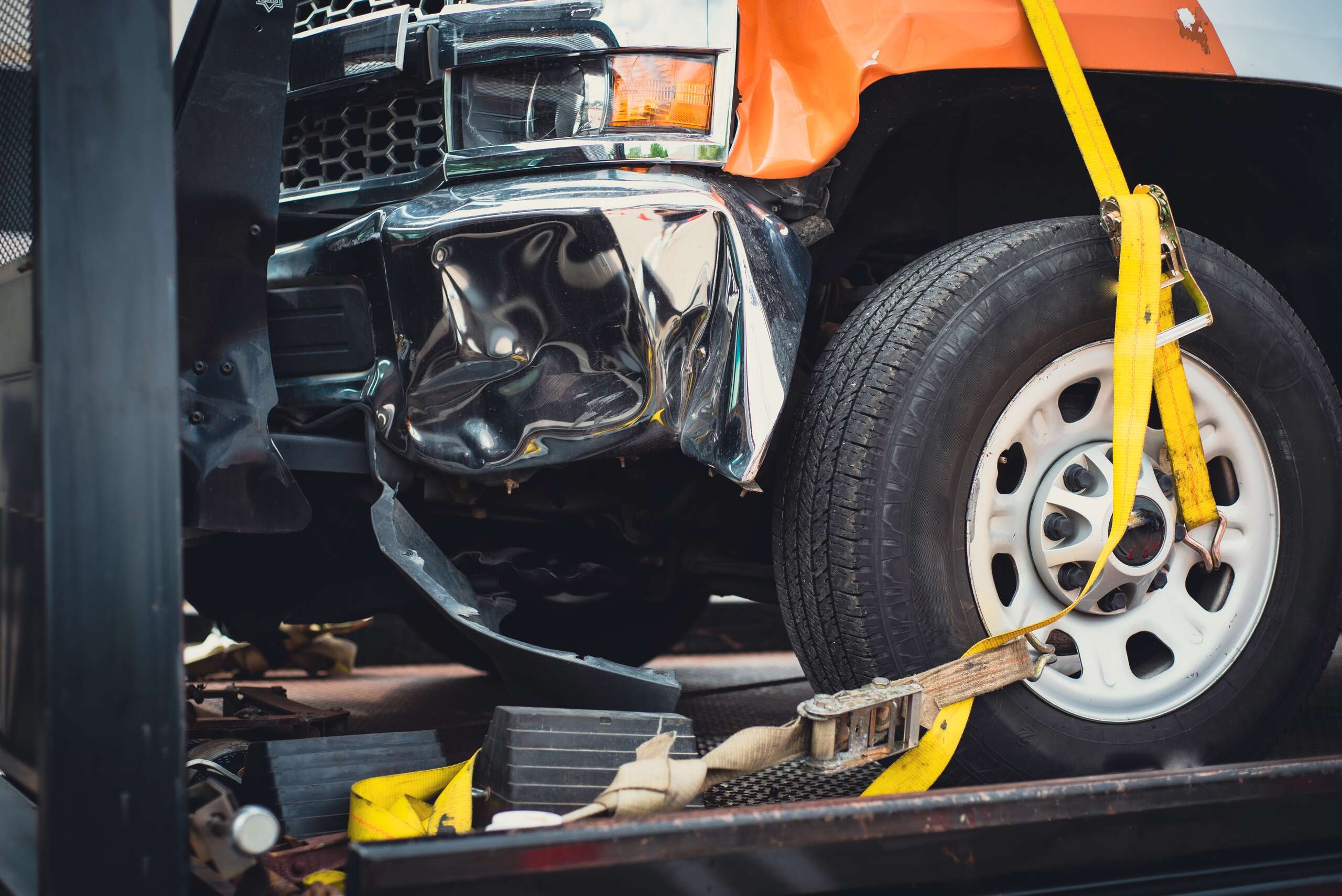
A tractor-trailer pulls out of the Packer Avenue Marine Terminal, merges onto I-95 without room, and hits your car.
Before you leave the hospital, the motor carrier already has an adjuster, an investigator, and a defense lawyer working on its side of the story.
You need someone working on yours just as fast. When you look for a Philadelphia truck accident lawyer, look for one who starts that work right away.
The Slocum Firm represents people hurt by tractor-trailers, tankers, box trucks, and other commercial vehicles throughout Philadelphia from our Scranton office. We pursue every company that shared responsibility for the crash, not only the driver.
Truck claims are part of the broader work of our Philadelphia personal injury team, but they follow their own rules:
- Federal safety regulations
- Stacked insurance policies
- Evidence that starts disappearing the week of the crash
Call (570) 209-7376 to reach The Slocum Firm, 24 hours a day. No fees unless we win.
Why Is a Truck Crash Case Different From a Car Accident Claim?
A truck crash claim involves federal safety law, corporate defendants, and several layers of insurance. The trucking company also controls most of the evidence, and federal rules allow it to discard some of that evidence within months.
Under 49 C.F.R. § 387.9, for-hire interstate carriers hauling general freight must carry at least $750,000 in liability coverage. Many carry far more. One crash often involves:
- The motor carrier’s primary auto liability policy
- Excess or umbrella coverage stacked above the primary limits
- A freight broker’s contingent liability policy
- Separate policies held by the trailer owner or the shipper
Each insurer has its own adjuster and defense lawyers, and each one benefits by pointing at another.
Truck Crashes on Philadelphia’s Freight Corridors

We handle every type of commercial truck crash in Philadelphia, from 18-wheeler wrecks on the interstates to city delivery and dump truck collisions. A tractor-trailer accident lawyer on our team looks first at where the crash happened, because each of the city’s freight corridors produces its own crash pattern:
- I-95 near the Port of Philadelphia: Container haulers leaving the Packer Avenue and Tioga terminals merge into commuter traffic, causing sideswipe and underride crashes. Underride means a smaller vehicle slides beneath the trailer.
- I-76 (Schuylkill Expressway): Tight curves and short merge lanes lead to jackknife and rear-end crashes, especially near the Valley Forge interchange with the Pennsylvania Turnpike.
- Roosevelt Boulevard: Trucks making wide right turns across the inner and outer lanes strike cars, cyclists, and pedestrians.
Compared with passenger vehicle crashes in Philadelphia, these collisions involve heavier forces, more defendants, and a federal paper trail.
Who Is Liable After a Philadelphia Truck Accident?
After a Philadelphia truck accident, the motor carrier, freight broker, shipper or loader, and maintenance contractor may all share liability with the driver. Each one ties to Federal Motor Carrier Safety Administration (FMCSA) rules: the carrier must follow hours-of-service, driver qualification, and inspection requirements; the broker faces claims for choosing a carrier with a poor FMCSA safety record; the shipper answers for loads that break federal cargo securement standards; and the maintenance contractor answers for repairs that fall short of federal inspection and maintenance rules.
Pennsylvania measures your share of fault against all defendants combined, so naming every responsible company matters.
The Motor Carrier and Respondeat Superior
The motor carrier answers for its driver’s negligence under respondeat superior, a rule that holds employers responsible for employees’ on-the-job mistakes.
The carrier also faces direct claims for negligent hiring, retention, and supervision. Examples include:
- Hiring a driver with prior hours-of-service violations
- Keeping a driver on the road after a failed drug test
- Setting delivery windows that require illegal drive times
Freight Broker Liability After Montgomery v. Caribe Transport II
A freight broker arranges the shipment and picks the carrier. In a unanimous May 2026 decision, the U.S. Supreme Court held that federal law does not preempt state-law negligent hiring claims against brokers.
The ruling does not make brokers automatically liable. The claim still requires proof of carelessness, such as hiring a carrier with a conditional FMCSA safety rating and a record of driver, hours-of-service, and maintenance problems. That describes the carrier in Montgomery itself.
Shippers, Maintenance Shops, and Trailer Owners
Other companies often share the blame:
- Shippers and loaders who load and seal trailers at port terminals and I-95 distribution centers, when a shifted load tips a trailer
- Maintenance shops that performed careless brake, tire, or lighting work
- Trailer leasing companies that supplied defective or poorly maintained trailers
- Parts manufacturers, through a product liability claim alleging the part left the factory unsafe

FMCSA Violations That Prove a Trucking Company Was Negligent
The Federal Motor Carrier Safety Administration (FMCSA) sets minimum safety rules for commercial trucks. A violation often serves as strong evidence of carelessness, and five sets of records do most of the work.
| Regulation | Federal Rule | What It Requires | What Violation Shows |
|---|---|---|---|
| Hours of service | 49 C.F.R. Part 395 | Limits on driving and on-duty time, recorded by an ELD | Fatigued driving or dispatch pressure |
| Driver qualification | 49 C.F.R. Part 391 | A file with driving history, prior employer checks, and medical certification | Negligent hiring or retention |
| Drug and alcohol testing | 49 C.F.R. Part 382 | Pre-employment, random, and post-crash testing, plus Clearinghouse checks | Impaired driving the carrier ignored |
| Cargo securement | 49 C.F.R. §§ 393.100 to 393.136 | Tie-downs and blocking rated to hold the load in place | Shipper or loader liability for a shifted load |
| Inspection and maintenance | 49 C.F.R. Part 396 | Systematic maintenance, driver inspection reports, annual inspection | Known brake, tire, or lighting defects |
Hours of Service and ELD Records
The FMCSA Hours of Service of Drivers rule, 49 C.F.R. Part 395, sets these limits for property-carrying drivers:
- No more than 11 hours of driving after 10 consecutive hours off duty
- No driving after the 14th consecutive hour on duty
- A 30-minute break after 8 cumulative hours of driving
- No driving after 60 hours on duty in 7 days, or 70 hours in 8 days
An electronic logging device (ELD) records drive time automatically from the engine. We check ELD data against fuel receipts, Turnpike E-ZPass records, terminal gate times, and dispatch messages. Gaps between them often reveal a driver who broke the limits.
Qualification, Testing, Cargo, and Maintenance Records
The other four sets of records each tell part of the story:
- Driver qualification file (Part 391): The driver’s application, three-year driving record, prior employer safety history, medical certificate, and annual review. A thin file supports a negligent hiring claim.
- Drug and alcohol testing (Part 382): Carriers must check the FMCSA Drug and Alcohol Clearinghouse before hiring and every year after. Federal rules bar a commercial driver from duty at 0.04 blood alcohol, half the limit for most drivers.
- Cargo securement (§§ 393.100 to 393.136): Tie-downs and blocking must hold the load through a hard stop (0.8 g forward) and sharp turns (0.5 g sideways).
- Inspection and maintenance (Part 396): Carriers must systematically inspect and maintain trucks, and drivers must file inspection reports that document defects.
After a fatal crash, or a crash involving a citation plus an injury treated away from the scene or a towed vehicle, 49 C.F.R. § 382.303 requires the carrier to test the driver for alcohol within 8 hours and for drugs within 32 hours.
What Evidence Disappears After a Philadelphia Truck Crash?
The most valuable evidence sits with the trucking company, and much of it gets overwritten or lawfully discarded within days to months unless someone demands that it be preserved. Each record runs on its own clock.
| Evidence | What It Records | How Long It Lasts |
|---|---|---|
| ECM (black box) data | Speed, braking, and throttle in the seconds before impact | Often overwritten once the truck returns to service |
| ELD logs | Drive time, duty status, location | Carriers must keep six months |
| Dashcam and telematics video | Road-facing and driver-facing footage | Some systems record over footage within days |
| Dispatch and trip records | Delivery deadlines, routes, messages to the driver | Supporting documents kept six months |
| Driver inspection reports | Defects the driver reported | Three months |
| Maintenance records | Repairs and inspections | One year, and six months after the truck leaves the carrier |
How Does a Spoliation Letter Protect Your Case?
Spoliation means the destruction or loss of evidence. A spoliation letter, also called a preservation letter, formally tells the carrier to keep specific records, devices, and the truck itself.
After that notice, a Pennsylvania court might sanction a carrier that destroys evidence. One sanction lets the jury assume the missing evidence hurt the carrier.
Our first days on a truck case typically include:
- Sending preservation letters to the carrier, broker, shipper, and trailer owner
- Arranging an independent download of ECM and ELD data
- Inspecting the truck and trailer before repairs
- Pulling the carrier’s FMCSA safety record through its USDOT number
- Searching for business security and traffic cameras near the crash site
That work only helps if it starts early. That is why calling within days of a truck crash matters.
The carrier’s response team often reaches the scene within hours. The Slocum Firm is available 24/7 at (570) 209-7376. Call as soon as you are able, so the work of preserving your evidence starts early.

How Do Trucking Companies Shift Blame Under Pennsylvania’s 51% Rule?
Under 42 Pa.C.S. § 7102, you recover damages only if your share of fault is 50% or less, measured against all defendants combined. Your award drops by your percentage of fault. At 51%, you recover nothing.
That is why carriers work hard to blame the injured driver. Common defense arguments include:
- You braked suddenly in front of the rig
- You lingered in the truck’s blind spot
- You sped through a Schuylkill merge
Defense teams also pull your phone records and your car’s own data to support those arguments.
A hypothetical example, for illustration only. A jury values your injuries from a crash on the Schuylkill Expressway near the Girard Avenue exit at $400,000 and assigns fault this way:
| Party | Share of Fault |
|---|---|
| You | 20% |
| Motor carrier | 60% |
| Freight broker | 20% |
Your recovery drops by 20% to $320,000. Under Pennsylvania’s Fair Share Act, a defendant 60% or more at fault owes the entire award, so you may collect the full $320,000 from the carrier even if the broker’s share goes unpaid.
Now change one fact. Without the broker in the case, the defense gains room to push your share above 50%. At 51%, that $400,000 claim is worth nothing.
Filing Deadlines for Philadelphia Truck Accident Claims
Two deadlines matter most in a Philadelphia truck case:
- Two years to file a personal injury lawsuit under 42 Pa.C.S. § 5524. Settlement talks do not pause the clock. Wrongful death claims generally run two years from the date of death. A survival claim, which covers the losses your loved one suffered before death, might run from the date of the injury instead, so its timing depends on the facts.
- Six months to give written notice under 42 Pa.C.S. § 5522 when a government vehicle or road is involved, such as a City of Philadelphia sanitation truck, a SEPTA vehicle, a PennDOT truck, or a road defect.
Pennsylvania also caps damages in many claims against government entities, which makes identifying private defendants even more important.
Compensation Available After a Philadelphia Truck Crash
Truck crash victims in Pennsylvania may recover economic losses, non-economic losses, and in some cases punitive damages. Future losses are often the largest part of the claim. Recoverable damages typically include:
- Medical bills already incurred
- Future medical care, often documented through a life care plan, which projects lifetime treatment needs and costs
- Lost wages and reduced earning capacity
- Pain and suffering, emotional distress, and loss of enjoyment of life
- Punitive damages where the conduct shows reckless indifference
Punitive damages punish outrageous conduct. Pennsylvania allows them when a defendant showed reckless indifference to the safety of others, such as falsified driver logs, a dispatcher pushing a driver past the 11-hour limit, or a carrier that kept an impaired driver on the road.
If you chose limited tort on your own policy, a truck case might still allow a full pain and suffering claim. Under 75 Pa.C.S. § 1705, the limited tort bar does not apply when the at-fault driver operated a vehicle registered in another state, and many interstate tractors carry out-of-state plates.
Different rules apply if a truck crash took the life of a family member. Pennsylvania’s Wrongful Death Act and Survival Act allow claims for funeral costs, lost financial support, and your loved one’s losses before death.

Why Does Filing in the Philadelphia County Court of Common Pleas Matter?
Venue is the court that hears your case. It affects value because insurers base settlement offers partly on how juries in that county have ruled in similar cases.
Philadelphia truck crash lawsuits are generally filed in the Philadelphia County Court of Common Pleas. Three factors shape venue:
- Where defendants do business: Pennsylvania allows a suit against a corporation in any county where it regularly conducts business, so a Turnpike crash in Montgomery or Bucks County often still qualifies for a Philadelphia filing. The Pennsylvania Supreme Court’s 2023 decision in Hangey v. Husqvarna Professional Products addressed how courts measure that activity.
- Transfer fights: Defendants often ask to move a case to another county, so the venue gets argued early.
- Case size: Philadelphia sends claims of $50,000 or less to compulsory arbitration before a panel of three attorneys. Serious truck injury cases proceed in the court’s major jury program instead.
No Fees Unless We Win: How We Handle Truck Cases
The Slocum Firm handles Philadelphia truck accident cases on a contingency fee basis, and consultations are free. No fees unless we win.
We have represented injured Pennsylvanians from our Scranton office since 2009, and we take truck cases across the state, including Philadelphia. When you call, you get:
- Availability by phone, 24 hours a day
- More than 50 years of combined legal experience
- A recovery rate above 95%
Results vary by case, and prior outcomes do not guarantee a similar result.

FAQs: Philadelphia Truck Accident Lawyer
Who may be sued after a truck accident in Philadelphia?
You may sue any person or company whose negligence contributed to the crash. That often includes the driver, motor carrier, freight broker, shipper, maintenance shop, and trailer owner.
Every defendant must be named before the filing deadline, because courts usually refuse to add new defendants once it passes.
How long do I have to file a truck accident lawsuit in Pennsylvania?
Most adults have two years from the crash date to file. For an injured child, Pennsylvania generally starts the two-year clock on the child’s 18th birthday under 42 Pa.C.S. § 5533(b).
That extra time does not apply to the six-month notice required for claims against government entities. Missing a deadline generally ends the right to sue, no matter how strong the evidence looks.
What is an ELD, and why does it matter in my truck accident case?
An ELD, or electronic logging device, is a federally required recorder that tracks a truck driver’s drive time, duty status, and location directly from the engine.
Unlike old paper logbooks, an ELD keeps a history of every edit, including who made it and when. Those edit histories sometimes show a dispatcher changing a driver’s status after the crash.
How much is a Philadelphia truck accident case worth?
No formula sets the value of a truck accident case. Value depends on the severity and permanence of your injuries, your future medical needs, the insurance available across every defendant, the strength of any FMCSA violation evidence, and the venue where the case proceeds.
Online settlement calculators ignore most of those factors. An honest evaluation from a truck accident attorney starts with your medical records and the carrier’s records.
Do I need a lawyer if the trucking company’s insurer already called me?
A quick call from the carrier’s insurer means the company has already opened its file and started building its defense.
You have no obligation to give a recorded statement to another driver’s insurer, and anything you say might later support an argument that you caused the crash. Early offers often arrive before doctors understand your injuries, and signing a release ends the claim.
Is the trucking company responsible if the driver was an independent contractor?
Often, yes. Many owner-operators lease their trucks to a motor carrier and haul under that carrier’s USDOT number. Federal leasing rules at 49 C.F.R. § 376.12 require the carrier to take exclusive possession and control of the equipment during the lease.
That requirement often defeats the independent contractor defense, so we review the lease and operating authority early.
How do I find out which company owned the truck that hit me?
Start with the USDOT number on the cab door, which usually appears on the police crash report too. That number links to the carrier’s registration and safety record in the FMCSA’s public SAFER database.
The company on the door is not always the only owner, so we also trace the trailer, the lease, and the broker.
Does my own car insurance pay my medical bills after a truck crash in Pennsylvania?
Yes, up to your policy’s medical benefit limit. Under 75 Pa.C.S. § 1711, every Pennsylvania auto policy must include at least $5,000 in medical benefits that pay regardless of fault.
Truck injuries usually exceed that amount quickly, and the claim against the trucking company seeks the remaining losses.
Do Philadelphia truck accident cases go to trial?
Most truck cases resolve through settlement, but the settlement amount depends on how ready the case is for trial. Carriers and their insurers study the evidence, the venue, and the legal team before making a serious offer.
We prepare every truck case as though it is headed to a Philadelphia jury, because that preparation drives the negotiation.
The Trucking Company Is Already Building Its Case
If you or someone you love was hurt by a tractor-trailer in Philadelphia, the trucking company’s investigators are already working.
Call The Slocum Firm now at (570) 209-7376. We’re available 24/7. No fees unless we win.