Quick Answer
You do not have to prove the store actually knew about the hazard to recover compensation in a Pennsylvania slip and fall case. Liability may be based on:
- Actual notice — the store was directly aware of the hazard
- Constructive notice — the hazard existed long enough that the store should have known
- Failure to inspect — the store did not follow reasonable safety checks
Even without direct proof, you can still build a strong case using circumstantial and forensic evidence.
You’re walking through a grocery store in Scranton, looking at your shopping list, when you suddenly slip on a spill and hit the ground. You are now dealing with pain and uncertainty about how you will pay for your medical expenses. As you recover, a question usually follows: “Do I have to prove the store manager actually saw that spill?”
In most cases, the answer is no. Pennsylvania law does not require direct proof that a store employee saw the hazard. Instead, many cases are built on a concept called constructive notice, which allows you to prove that the hazard existed long enough that the store should have discovered and fixed it.
Understanding how constructive notice works in slip-and-fall cases in PA can help you better evaluate your situation and determine whether you have a viable injury case.
Key Takeaways About Constructive Notice in Pennsylvania Slip and Fall Cases
- You do not need direct proof that a store employee saw the hazard
- Constructive notice focuses on how long the condition existed
- Stores have a duty to regularly inspect and maintain safe conditions
- Circumstantial evidence can be used to prove how long a hazard was present
- These cases are often decided based on evidence rather than direct testimony
What Is Constructive Notice?
Constructive notice is a legal concept that holds a property owner or business accountable for a dangerous condition, even if they did not actually see it. Basically, if the hazard existed for a sufficient amount of time that the property owner should have found it with a reasonable inspection, they can be held liable for an accident victim’s injuries and losses.
In a slip and fall case, this means you do not have to prove that an employee witnessed the spill or hazard. Instead, you must show that the condition existed long enough that a reasonable business would have discovered it through proper inspection and maintenance. This shifts the focus from what the store actually knew to what it should have known.
The Difference Between Actual Notice and Constructive Notice
Let’s look at the difference between these two concepts to clarify how these cases are built.
Actual notice occurs when a store employee directly observes or is informed of a hazard. For example, if a customer reports a spill and the store does nothing, that is actual notice.
Constructive notice, on the other hand, is based on time and circumstances. It asks whether the hazard was present long enough that the store should have found it by exercising reasonable care.
Most slip and fall cases rely on constructive notice because direct proof of someone’s actual knowledge is often hard to prove. When you partner with an experienced Scranton premises liability lawyer, they can investigate the circumstances of your accident to determine if actual or constructive notice applies to your claim.
Why Stores Have a Duty to Inspect for Hazards
Pennsylvania premises liability laws incorporate federal rules that state that businesses that invite customers onto their property have a responsibility to maintain safe conditions. This includes regularly inspecting the premises for hazards.
In grocery stores and other retail settings, spills, dropped items, and debris are common. Because these risks are predictable, stores are expected to have systems in place to identify and address them, such as:
- Routine floor inspections
- Employee monitoring of high-risk areas
- Cleaning procedures and response protocols
If a store fails to follow reasonable inspection practices, it may be held responsible for injuries that occur.
How Do You Prove the Store Should Have Known?
This is where forensic and circumstantial evidence becomes critical. Even without video footage or direct testimony, the condition of the hazard itself can provide important clues about how long it was present.
Courts often look at evidence that helps answer a key question: Was the hazard present long enough for a reasonable store to have discovered it? The relevant facts will vary from case to case, so it’s crucial to present a strong argument to show how the store should be held responsible.
Physical Clues That Help Prove Constructive Notice
In many cases, the hazard leaves behind evidence that tells a story. For example, footprints or cart tracks through a spill may suggest that multiple people passed through the area before the fall. This can indicate that the hazard existed for a period of time.
Other signs may include:
- Dirt or debris mixed into the substance
- Edges of a spill that appear dried or sticky
- Smearing or spreading consistent with repeated contact
These details may seem small, but they can help establish how long the condition existed.
The Role of Surveillance Video
Video footage can be one of the most powerful forms of evidence in these cases, but it is not always available. When footage exists, it may show:
- When the hazard first appeared
- How long the hazard was not cleaned or removed
- Whether employees passed by without taking action
However, even without video, a case can still be built using other forms of evidence. In some situations, video evidence may be destroyed or overwritten if no one requests its preservation. A skilled personal injury attorney can take legal action to protect important evidence to build your case.
What If There Is No Video Evidence of the Hazard?
Many people assume that without video proof, there is no case. That is not true. Slip and fall cases are often built on a combination of physical evidence, witness observations, and expert analysis.
For example, an accident reconstruction expert may evaluate the scene and determine how long a hazard likely existed based on its condition. Employees may also provide testimony about inspection routines or when the area was last checked. These pieces of evidence can work together to support a claim of constructive notice.
Why Do Inspection Logs and Store Policies Matter?
Stores often maintain records of their inspection and cleaning routines. These logs can show when an area was last inspected, whether inspections were performed regularly, and whether employees followed established procedures to keep the premises safe.
If a store cannot produce these records, or if they show gaps in inspections, it may support an argument that the store failed to exercise reasonable care for its customers.
Why Timing Is Critical in These Cases
Timing plays a central role in proving constructive notice. A spill that occurred seconds before a fall may not create liability because the store did not have a reasonable opportunity to respond.
However, a hazard that existed for an extended period without being addressed may indicate negligence. This is why it’s important to gather evidence that helps establish a timeline as quickly as possible. If you are unable to act, talk to a reputable lawyer who will investigate on your behalf.
Real-World Example of Constructive Notice
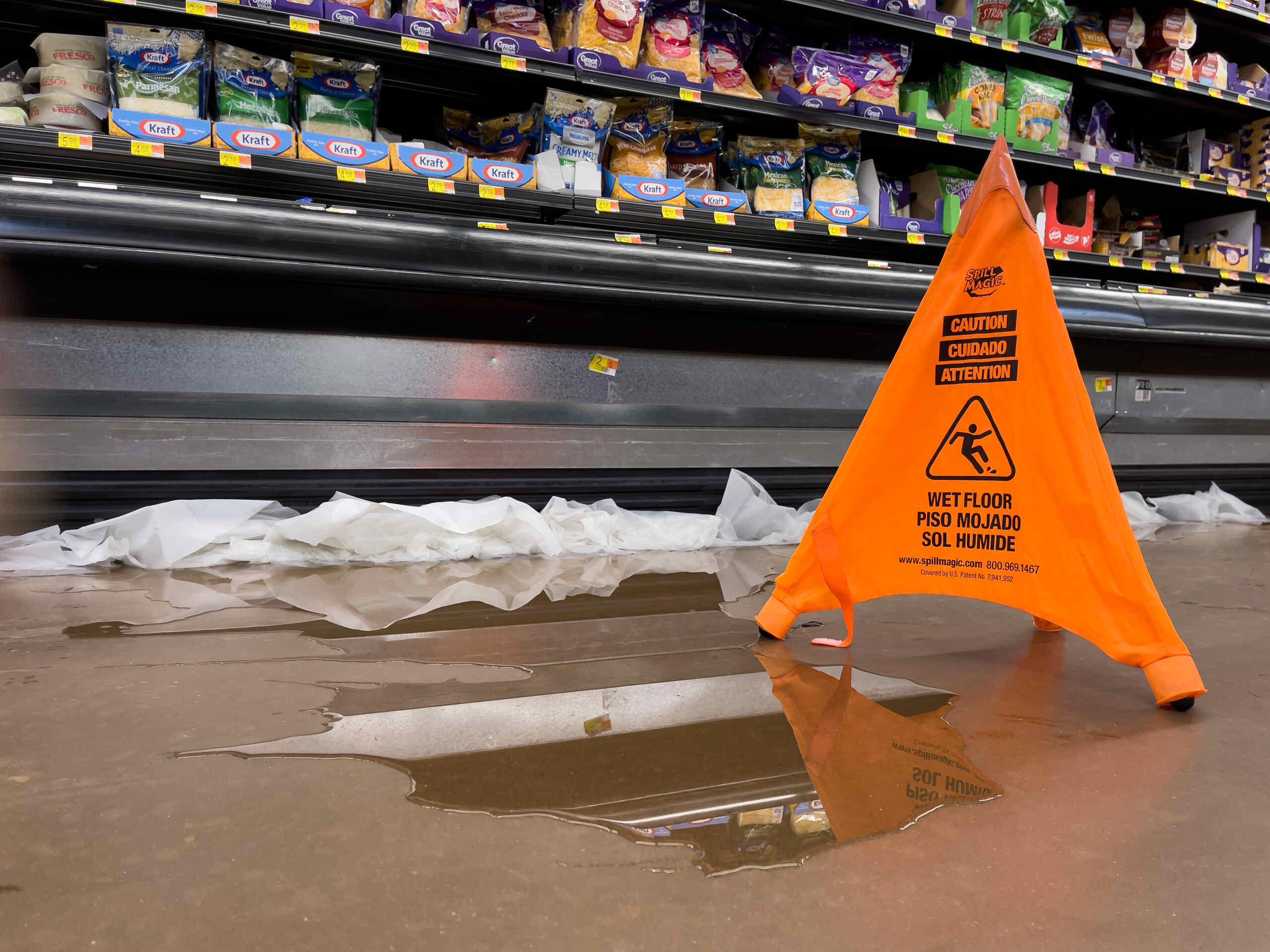
Sometimes it’s easier to understand legal concepts when they are applied to a common situation we’ve all experienced. In our example, a customer slips on a liquid spill in a supermarket aisle.
There is no direct evidence that an employee saw the spill. However, the liquid has footprints and cart marks running through it, and the edges appear partially dried.
These details suggest that the spill was present long enough to dry a bit and allow multiple people to encounter it before the accident occurred. In this situation, a court may find that the store should have discovered and cleaned the hazard.
How Constructive Notice Is Proven in Slip and Fall Cases
| Type of Evidence | What It Shows | Why It Matters |
| Footprints or cart tracks | Multiple people walked through the spill | Indicates the hazard existed long enough to be noticed |
| Dirty or dried edges | The spill has started to change over time | Suggests the condition was not recent |
| Spread or smearing | Repeated contact with the substance | Shows the hazard remained unaddressed for a while |
| Missing inspection logs | Lack of routine monitoring | Supports failure to follow safety procedures |
| Employee inaction | Staff walked past without fixing the issue | Suggests the store should have addressed the hazard |
Small details at the scene can help establish how long a hazard existed—and whether a store should have discovered it.
How Insurance Companies Respond to These Claims
Insurance companies often argue that there is no proof that the store knew about the hazard. They may claim that the spill occurred moments before the fall, that there was no opportunity to clean it up, or that there is no direct evidence of knowledge on the store’s part.
These arguments are designed to limit the insurer’s liability, but they can be challenged with the right evidence. This is when you need a tenacious premises liability attorney in your corner, fighting for your rights.
What Can You Do While Recovering From a Slip and Fall?
After a fall, your priority should be your recovery, but you can help support your claim by following these suggestions.
Following your doctor’s treatment plan and attending all appointments is important for both your health and documentation. Keeping records of your medical care, expenses, and how the injury affects your daily life can provide valuable context.
If you are contacted by an insurance company, it is important to proceed cautiously.. Early statements or settlement offers may not reflect the full impact of your injuries or the strength of your case.
Don’t try to resolve this matter on your own. Set up a free consultation with a knowledgeable injury lawyer to learn more about your legal rights.
Frequently Asked Questions About Proving Constructive Notice
Do I need a witness to prove the store knew about the hazard?
No. While witness testimony can be helpful, it is not required. Many cases rely on circumstantial evidence, such as the condition of the hazard or inspection records, to show that the store should have known about the issue.
How long does a spill need to be present to establish constructive notice?
There is no exact time requirement. The key issue is whether the hazard existed long enough that a reasonable store would have discovered it. This depends on the specific facts, including the type of business and the frequency of inspections.
Can a store be liable if another customer caused the hazard?
Yes, in some situations. Even if another customer created the hazard, the store may still be responsible if it failed to discover and address the condition in a reasonable time.
What if the store claims they inspected the area shortly before my fall?
This may become a key issue in the case. Inspection logs and employee testimony may be reviewed to determine whether inspections were actually performed and whether they were reasonable under the circumstances.
How long do I have to file a slip and fall lawsuit in Pennsylvania?
In most cases, the Pennsylvania statute of limitations gives you two years from the date of the injury to file a lawsuit. Acting quickly can help preserve evidence and strengthen your claim.
Talk to a Scranton Personal Injury Attorney at The Slocum Firm to Learn More About Your Slip and Fall Case
A slip and fall injury can leave you dealing with pain, financial stress, and uncertainty about your rights—especially if you have been told there is no proof the store knew about the hazard.
Reach out today to speak with an attorney at The Slocum Firm, P.C. who can answer your questions and explain your rights. We are available 24/7, and you will never pay a fee unless we recover compensation for you.
Since 2009, our team has helped injured clients across Pennsylvania recover millions of dollars, maintaining a 95% recovery rate. When you call, you will speak directly with an attorney who can review your situation, explain how constructive notice may apply, and help you take the next step.
If you were injured in a slip and fall in Scranton or anywhere in Pennsylvania, call (570) 209-7376 today for a free consultation and get clear answers about your rights.