Summer in Philadelphia means pool days: neighborhood kids splashing at a Philadelphia Parks and Recreation pool, families spending weekends at a private swim club along the Main Line, and hotel guests cooling off at a rooftop pool near the convention center. Most of those afternoons end exactly the way they should, with sunburned shoulders, waterlogged ears, and tired kids. Some do not.
A swimming pool accident can happen in the time it takes a lifeguard to look away, and the outcome is rarely minor. When a pool owner or operator’s negligence contributed to a drowning, a near-drowning, or a serious injury, Pennsylvania law gives your family a path toward accountability, and The Slocum Firm is prepared to walk that path with you.
These cases carry a particular weight most personal injury claims do not, because a pool accident often happens in front of other swimmers, parents, and children. Our job is not only to calculate a settlement figure, but to help a family put together the resources they will need to rebuild.
Call The Slocum Firm at (570) 209-7376 to talk through what happened. We answer at any hour, and it costs nothing to have us look at your case.

How Do Most Pool Accidents Happen?

Pool accidents take several distinct forms, and each raises different legal questions. Drowning and near-drowning incidents usually trace back to inadequate supervision, an absent or distracted lifeguard, or unsecured access that let a child reach the water alone. Drain entrapment, which occurs when suction from a faulty or outdated drain holds a swimmer against it, is rare but catastrophic.
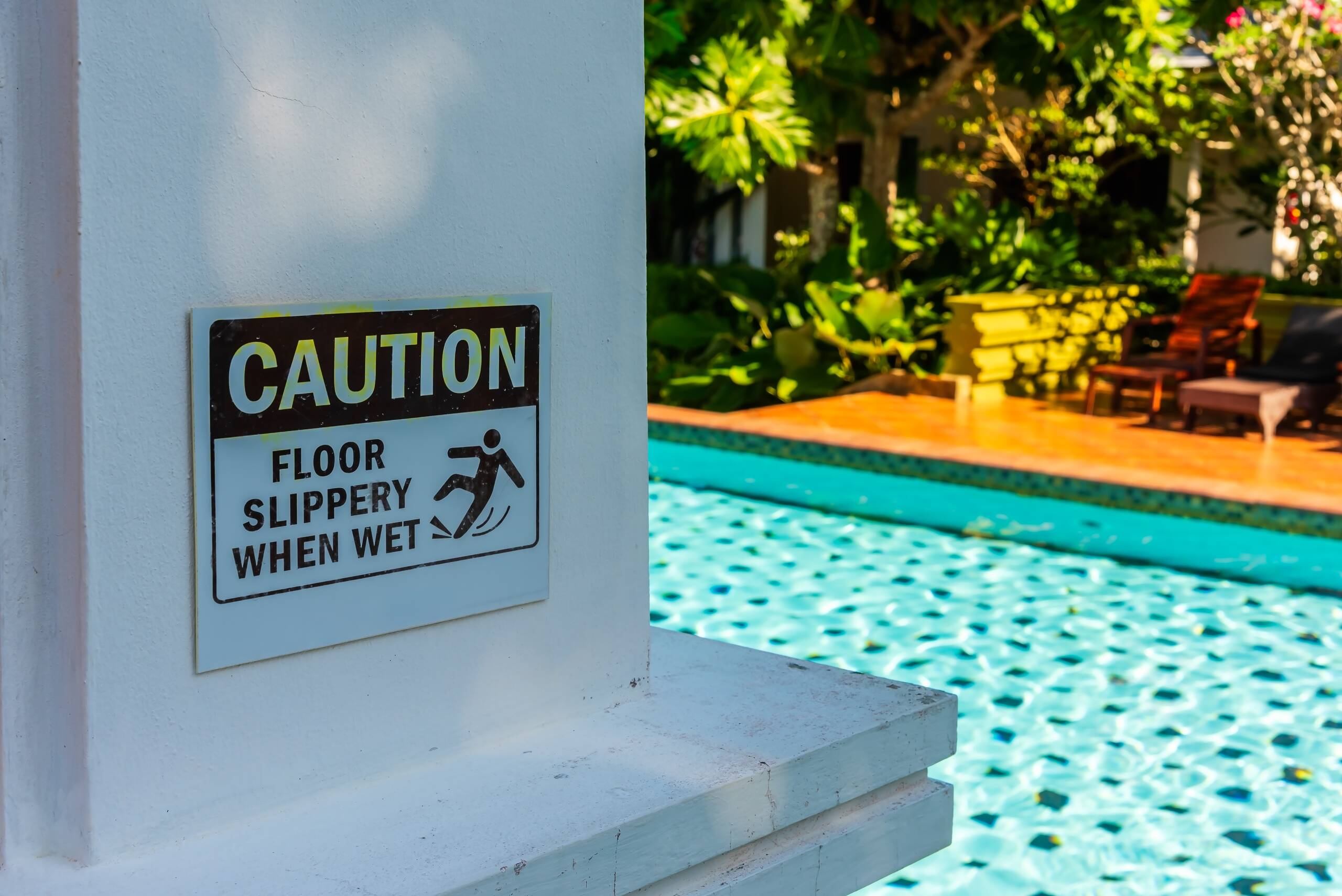
Diving injuries are usually spinal cord injury claims arising from inadequate depth markings or an unmarked shallow area. Slip and fall accidents on wet decks, diving board malfunctions, equipment failures such as broken ladders or gates, and chemical exposure from improper chlorination each form their own category. Pool enclosure failures that let a child reach the water unsupervised are among the most preventable of all.
These categories often overlap. A child who slips through a broken gate and then goes unnoticed in the water may support both an enclosure failure claim and a negligent supervision claim. Identifying every angle of liability early, rather than stopping at the most obvious cause, is often what separates a fair recovery from a partial one.
Who Is Legally Responsible for Keeping a Pool Safe?
Pennsylvania premises liability law assigns different duties depending on a visitor’s legal status. Patrons at a commercial pool, whether a public facility, a private swim club, or a hotel pool, are generally invitees, meaning someone the owner invited on for business reasons, and they are owed the highest duty Pennsylvania recognizes: the owner has to inspect for hazards and either correct them or warn about them.
That duty applies whether the pool is run by Philadelphia Parks and Recreation, a private club in Northeast Philadelphia or the surrounding suburbs, or a hotel along the convention center corridor.
Pennsylvania adopts the International Swimming Pool and Spa Code as part of its Uniform Construction Code, which sets the barrier requirements a pool has to meet, including fencing standards and self-closing, self-latching gates. Public and commercial pools in Philadelphia also operate under the Commonwealth’s Public Bathing Law and the Department of Health regulations issued under it, at 28 Pa. Code Chapter 18.
Those regulations require at least one certified lifeguard for every 4,000 square feet of water surface, a minimum of two lifeguards whenever the pool is open to the public, and a lifeguard stationed within 50 feet of any diving well or water slide. A pool operating below those ratios is not meeting the standard the regulation sets.
Federal law adds another layer. The Virginia Graeme Baker Pool and Spa Safety Act, at 15 U.S.C. Section 8003, requires anti-entrapment drain covers meeting a federal performance standard on public, semi-public, and commercial pools, a requirement put in place after a series of fatal entrapment incidents. It does not reach private single-family backyard pools, though it does cover pools serving apartment and condominium residents, hotels, and clubs.
Where a covered pool was operating without compliant covers, that failure is strong evidence of negligence in an entrapment case.
When a Lifeguard Fails to Watch the Water
Negligent supervision claims are the backbone of many drowning and near-drowning cases. If a lifeguard failed to maintain proper visual coverage of the water, was distracted, or the facility was simply understaffed for the number of swimmers present, that failure can support a negligence claim under Pennsylvania law.
These cases come down to seconds, and to whether anyone was actually watching. A facility running at the bare regulatory minimum with hundreds of swimmers in the water has far less margin for error than one that staffs above it at peak hours.
When we investigate a drowning or near-drowning, we pull staffing schedules, incident logs, and training certification records to establish what coverage the facility actually had that day.

When the Victim Is a Child on Someone Else’s Property
Pennsylvania recognizes what is often called the attractive nuisance doctrine, a rule that can make a property owner responsible for injuries to a child who was not invited onto the property. Pennsylvania courts apply it through Section 339 of the Restatement (Second) of Torts, which sets out five requirements that all have to be met.
The owner has to have known or had reason to know that children were likely to come onto the property, and to have known or had reason to know the condition posed an unreasonable risk of serious injury or death to them. The child, because of their age, must not have discovered the condition or understood the risk. The burden of removing the danger must have been slight compared with the risk to children, and the owner must have failed to take reasonable care to remove it.
A residential pool without a compliant fence and self-latching gate is the situation this rule is most often raised in, because a pool is exactly the kind of feature a young child will go toward regardless of whether anyone invited them.
The reasoning is that a young child cannot weigh the risk a pool represents, so the law puts responsibility for preventing access on the adult who created and maintains the hazard. Whether the doctrine applies to a particular pool turns on what the owner knew and what it would have taken to secure the water.
The Losses a Near-Drowning Claim Has to Account For
A near-drowning claim is not measured by the hospital bill. Families are often asked to settle before anyone knows what long-term support a child will need. That gap between what is known at settlement and what a family will actually face is the central problem in these cases.
We handle it the way we handle any catastrophic injury claim, by building the damages case before the settlement conversation rather than after it. A certified life care planner projects the cost of future care, therapy, and educational support. A vocational evaluator assesses the effect on future earning capacity, and a forensic economist reduces those projections to present value.
How Long Do You Have to File a Pool Accident Claim?
Pennsylvania generally gives adults two years from the date of injury to file a lawsuit under 42 Pa.C.S. § 5524. For an injured child the clock is paused, or tolled, until the child turns 18. Under 42 Pa.C.S. Section 5533, a child injured at age 6 generally has until their 20th birthday to bring a claim.
That longer window comes with an important exception. If the pool was operated by the City of Philadelphia or another government body, a separate written notice of the claim is generally required within six months of the injury under 42 Pa.C.S. Section 5522, and whether a child’s age extends that six-month notice period is an unsettled question. Do not assume a child’s claim against a public pool can wait.
Evidence degrades long before any deadline arrives. Staffing records, maintenance logs, and witness memories all fade or disappear, so a strong case usually depends on preserving them early.

What Can a Pool Accident Claim Recover?
A pool accident claim can recover medical bills, future rehabilitation and care, lost wages, pain and suffering, and compensation for permanent disability. Where a drowning was fatal, the claim splits in two: a wrongful death claim for what the family lost, and a survival claim, brought for the estate, for what the person who died could have claimed.
In a serious case the future categories usually decide the value, because present bills are already documented while decades of care and lost earning capacity still have to be projected and proven.
Call us at (570) 209-7376 before you accept any figure from an insurer, so you know what the claim is actually worth first.
Why Families Trust The Slocum Firm With These Cases
Pool accident cases involving children carry a weight beyond the legal questions in them, and we handle them with that in mind. The Slocum Firm has represented injured Pennsylvanians since 2009. We practice from our office in Scranton, Lackawanna County, and our attorneys are admitted to the United States District Court for the Eastern District of Pennsylvania, which covers Philadelphia and the surrounding counties.
Every family works directly with the attorney handling their case rather than a rotating group of case managers, and that attorney is reachable at any hour. Across our practice we have recovered in more than 95 percent of the cases we have taken, and our attorneys bring more than 50 years of combined experience to holding pool owners, operators, and equipment manufacturers to the safety standards that apply to them.
Results may vary. Prior case outcomes do not guarantee similar results.
We take pool accident cases on contingency, so you pay nothing upfront and owe no attorney fee unless we recover compensation for you. Case expenses are separate from the attorney fee, and we will explain exactly how they work before you decide anything. Call The Slocum Firm at (570) 209-7376 at any hour to find out where your family actually stands.
FAQs: Philadelphia Swimming Pool Accident Lawyer
Families ask us the same questions in the days after a pool accident, and these are the answers we give most often.
Can I sue a pool owner if my child was injured or drowned at their pool in Pennsylvania?
Yes, if the owner’s negligence, such as inadequate supervision, a broken barrier, or a failure to meet lifeguard staffing requirements, contributed to the injury. This applies to public pools, private clubs, hotel pools, and residential pools alike.
What is the attractive nuisance doctrine and how does it apply to pool accidents?
It is a legal rule that can hold a property owner responsible for injuries to a trespassing child if the owner knew children were likely to access a dangerous feature, like an unsecured pool, and failed to take reasonable steps to prevent that access.
What is drain entrapment and who is responsible for preventing it?
Drain entrapment happens when suction from a pool drain holds a swimmer against it, and the results are often catastrophic. Federal law requires anti-entrapment drain covers on public and commercial pools, though not on private backyard pools, and a facility without compliant covers can be held liable when entrapment occurs.
How long do I have to file a swimming pool accident lawsuit in Philadelphia?
Generally two years from the date of injury for an adult, and for an injured child the two years usually does not start until the child turns 18. If a city or government-run pool was involved, a written notice is generally due within six months regardless. Contact a lawyer early either way, because evidence disappears long before any deadline.
What if the pool was a public pool operated by the City of Philadelphia?
A claim against the City follows different rules. A written notice of the claim is generally due within six months of the injury, the case has to fit one of the narrow exceptions to governmental immunity, and total damages against a local agency are capped at $500,000 for everyone injured in the same incident combined. Call us quickly if a public pool was involved, because that six-month clock is the one that catches families out.
If Your Family Was Affected by a Pool Accident
Call The Slocum Firm at (570) 209-7376, at any hour, whether the accident happened this week or several months ago. You will speak directly with an attorney about what happened to your family and what can still be done about it. There is no attorney fee unless we recover compensation for you, and we will explain how case expenses are handled before you decide anything.