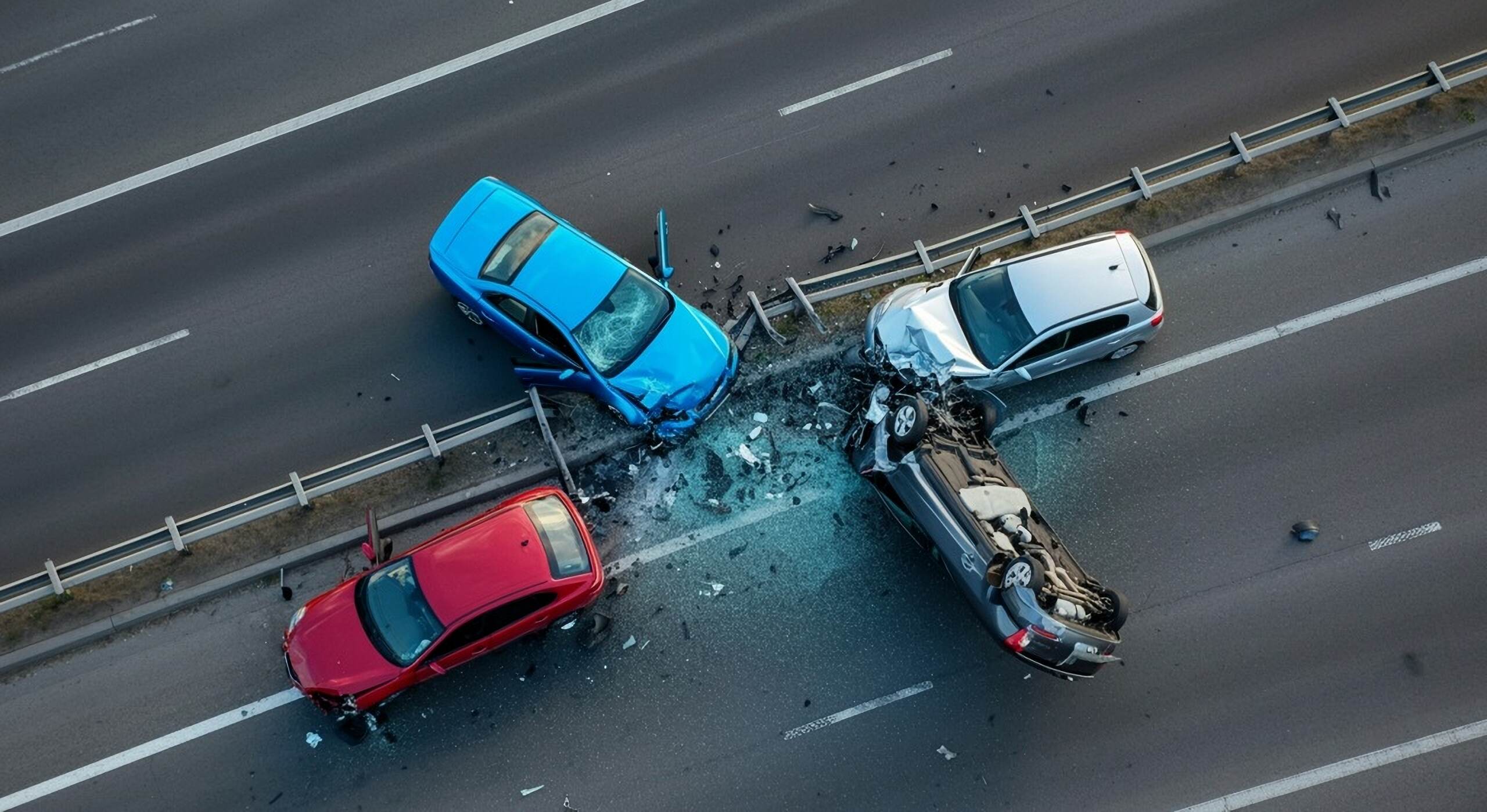
Determining fault in chain-reaction crashes on I-81 often comes down to identifying the initial act of negligence that set the pileup in motion.
However, I-81 accident liability in these cases rarely stops there. Multiple drivers may share responsibility for failing to maintain safe distances or react appropriately to sudden hazards.
These collisions, common on high-traffic stretches of I-81, create a maze of conflicting accounts and insurance disputes. Legal professionals can help untangle this complexity by examining critical evidence, such as black box data, accident reports, and witness statements, to pinpoint who is truly at fault.
If you’re facing challenges after a multi-vehicle accident, consider reaching out to The Slocum Firm, P.C., for a free case evaluation with our Scranton auto accident lawyers to explore how the following legal insights may affect your case.
Key Takeaways About I-81 Accident Liability
- Establishing the Proximate Cause: In a multi-vehicle accident liability case, identifying the driver whose initial negligence set the chain of events in motion is critical, but Pennsylvania’s modified comparative negligence rule means fault can be shared among several parties involved in the crash.
- The role of safe following distances: Many pileup injury negligence claims hinge on whether drivers were following too closely under Pennsylvania Vehicle Code Section 3310, which requires drivers to maintain a distance that is “reasonable and prudent.”
- Leveraging electronic evidence: A Scranton I-81 pileup accident lawyer can secure black box data and dashcam footage to reconstruct the accident sequence, proving that a client was an innocent victim caught in the pileup rather than a contributor to the crash.
- Overcoming Joint and Several liability complexities: Under Pennsylvania law, recovering compensation in a massive pileup often involves navigating joint and several liability principles, where legal counsel helps ensure that all responsible parties pay their fair share of the damages.
The Chaos of a Multi-Vehicle Accident on I-81
Interstate 81 acts as a major artery through Northeastern Pennsylvania, funneling thousands of trucks and passenger vehicles through Scranton every day.
When traffic density meets high speeds or sudden bad weather, the conditions become ripe for a chain-reaction crash. One driver slams on their brakes, the car behind them rear-ends them, and within seconds, a dozen vehicles are mangled in a pileup.
For the people involved, the immediate concern is safety. Once the dust settles, however, the question of I-81 accident liability arises. Unlike a simple fender bender between two cars, a chain-reaction crash involves numerous drivers, each with their own insurance company eager to deny responsibility.
You might know you were stopped safely before being hit from behind, but proving that in a chaotic scene with ten other cars requires more than just your word.
Legal professionals step in to bring order to this chaos. By launching an independent investigation, a lawyer can preserve critical evidence before it disappears.
Skid marks fade, road debris is cleared, and memories blur, but securing police reports, traffic camera footage, and vehicle data early on builds a foundation for a strong claim.
Identifying the First Domino: Proximate Cause in Pileups
The legal concept of proximate cause is central to determining fault in a multi-car accident. This refers to the primary action that initiated the collision.
In many I-81 crashes, it might be a distracted driver who didn’t notice traffic slowing near the Steamtown Mall exit, or a truck driver who lost control on an icy patch near the Central Scranton Expressway.
However, the first driver isn’t always the only one at fault. If the third vehicle in line was following too closely and couldn’t stop in time to avoid hitting the second vehicle—which had already been hit by the first—that third driver might share liability.
This is where joint and several liability Pennsylvania laws come into play. Multiple parties can be held responsible for the damages, depending on their percentage of fault. Unraveling these layers requires a deep understanding of how to reconstruct accident scenes.
Auto accident attorneys often collaborate with reconstruction specialists who can analyze the physics of the crash. They look at crush damage profiles and vehicle resting positions to determine the sequence of impacts.
This scientific approach helps distinguish between the driver who started the crash and the innocent victim caught in the pileup on I-81.
Discover the common causes of auto accidents in Scranton and see how local crash patterns may affect your rights and insurance claim.
The “Sudden Emergency” Defense and How to Counter It
Insurance companies representing at-fault drivers in massive highway crashes often try to use the “sudden emergency” doctrine to avoid liability.
They might argue that a sudden hazard, such as a deer darting onto the highway or an unexpected patch of black ice, created an unavoidable situation in which negligence didn’t play a part. If successful, this defense can leave injured victims without a path to compensation.
Fighting back against this defense requires showing that the emergency wasn’t truly sudden or unexpected. For example, if weather reports warned of freezing rain and other drivers were slowing down, a driver who continued speeding cannot claim the ice was a surprise.
A lawyer can pull meteorological data and compare it with the crash timeline. They can also look at the driver’s behavior leading up to the impact. Did they brake? Did they swerve? Or were they distracted by a phone?
Proving that the driver failed to act reasonably despite the conditions dismantles the sudden emergency defense and refocuses the case on negligent driving chain reaction accidents.
Following Too Closely: A Common Factor in Scranton Pileups
Pennsylvania law is clear about maintaining a safe following distance. Yet tailgating remains a leading cause of liability in highway crashes in Pennsylvania.
When vehicles are traveling at 65 mph or faster on I-81, the margin for error is razor-thin. If a driver is tailgating, they rob themselves of the time needed to react to a sudden stop ahead.
In a legal claim, establishing that a driver was following too closely often involves analyzing witness statements to prove liability in chain-reaction scenarios. Other drivers often see the aggressive behavior leading up to the crash.
Additionally, the damage to the vehicles can tell a story. A high-impact rear-end collision suggests the trailing driver didn’t brake significantly before impact, pointing to either distraction or following too closely.
Attorneys can use this evidence to establish negligence per se, meaning the driver violated a safety statute intended to prevent that specific type of harm. This strengthens the argument for compensation, as it shifts the burden of proof onto the defendant to show they weren’t negligent.
Following Too Closely: A Common Factor in Scranton Pileups
Pennsylvania law is clear about maintaining a safe following distance. Yet tailgating remains a leading cause of liability in highway crashes in Pennsylvania.
When vehicles are traveling at 65 mph or faster on I-81, the margin for error is razor-thin. If a driver is tailgating, they rob themselves of the time needed to react to a sudden stop ahead.
In a legal claim, establishing that a driver was following too closely often involves analyzing witness statements to prove liability in chain-reaction scenarios. Other drivers often see the aggressive behavior leading up to the crash.
Additionally, the damage to the vehicles can tell a story. A high-impact rear-end collision suggests the trailing driver didn’t brake significantly before impact, pointing to either distraction or following too closely.
Attorneys can use this evidence to establish negligence per se, meaning the driver violated a safety statute intended to prevent that specific type of harm. This strengthens the argument for compensation, as it shifts the burden of proof onto the defendant to show they weren’t negligent.
The Role of Black Box Data in Proving Fault
Many modern vehicles, especially commercial trucks and newer passenger cars, are equipped with Event Data Recorders (EDRs), commonly known as “black boxes.”
These devices record a snapshot of the vehicle’s systems in the moments before and during a crash. They capture vital data points such as:
- Vehicle speed: Was the driver speeding immediately before impact?
- Brake application: Did the driver attempt to stop, and if so, how hard did they brake?
- Throttle position: Was the driver accelerating?
- Steering input: Did the driver try to steer away from the collision?
- Seatbelt usage: Were the occupants restrained?
Securing this data requires quick action. Insurance companies for commercial trucking fleets often move quickly to put vehicles back into service or to salvage them, which can result in data loss. A Scranton I-81 pileup accident lawyer can send spoliation letters immediately after the crash, legally demanding that all electronic evidence be preserved.
Navigating Comparative Negligence in Pennsylvania
Pennsylvania follows a modified comparative negligence system. This means that you can still recover compensation even if you were partially at fault for the accident, as long as your share of the blame does not exceed 50%. However, your compensation is reduced by the percentage of fault you bear.
In a pileup, insurance adjusters love to assign widespread blame. They might argue that you, as the fifth car in the pileup, could have avoided the crash if you had been paying closer attention, assigning you 20% of the fault to save their company money.
Legal representation serves as a shield against unfair fault allocations. By rigorously analyzing the timeline and mechanics of the crash, a lawyer can demonstrate that you reacted reasonably to an unavoidable hazard created by someone else.
Protecting your right to full compensation means ensuring that shared fault in multiple vehicle accidents is assigned accurately, not conveniently for the insurers.
Dealing with Multiple Insurance Companies
One of the most frustrating aspects of a chain-reaction crash is the sheer number of insurance carriers involved.
You might have claims against the driver who started the crash, a driver who hit you from behind, and potentially a trucking company involved in the mix. Each carrier will point the finger at the others, delaying your settlement while medical bills pile up.
This bureaucratic gridlock is designed to wear you down. Insurers know that desperate victims are more likely to accept lowball settlement offers just to get the process over with.
A lawyer takes over these communications, coordinates the various claims, and demands a unified resolution. They understand the interplay between different policies and how to trigger coverage from multiple sources if the primary at-fault driver has insufficient insurance limits.
Why Witness Statements Are Crucial
In the confusion of a pileup, the drivers involved often have a fragmented view of what happened. They saw the car in front of them stop, but they didn’t see what caused the initial backup.
Independent witnesses—people who were in other lanes or on the side of the road—often have the best perspective on the entire sequence of events.
Witness statements proving liability in chain reaction cases can corroborate your version of events. A witness might confirm that a red sedan was weaving aggressively miles before the crash, establishing a pattern of negligent driving.
Or they might verify that the brake lights on the cars ahead were visible, countering a defendant’s claim that traffic stopped without warning.
Lawyers work to promptly locate and interview these witnesses. Their testimony can be the glue that binds the rest of the physical and electronic evidence, creating a narrative a jury or insurance adjuster can understand.
Chain-Reaction Car Crash Lawyer FAQs
What compensation can I recover if I am not at fault in a chain reaction car crash?
Compensation may include medical expenses, lost wages, and non-economic damages like pain and suffering. A lawyer can evaluate your case and help pursue the full recovery you may be entitled to under the law.
Who pays for my injuries in a multi-vehicle collision?
Liability depends on the circumstances of the crash, but a lawyer can identify the responsible parties and navigate the insurance claims process to secure compensation for your injuries.
How do I proceed if the truck driver was at fault for a highway accident?
An attorney can investigate the trucking company’s compliance with federal regulations, gather evidence like black box data, and hold the driver and their employer accountable for your injuries.
Let a Lawyer Handle the Challenges of I-81 Accident Liability
The insurance companies have teams of adjusters and lawyers working to pay you as little as possible. They understand the nuances of joint and several liability and comparative negligence, and they will use that knowledge to their advantage.
You deserve a level playing field. You deserve to focus on healing from your injuries while a dedicated professional fights for your financial recovery. Whether it’s securing black box data, interviewing witnesses, or negotiating with multiple insurers, having the right support can change the outcome of your case.
At The Slocum Firm, P.C., we have the experience and resources to untangle even the most complex highway pileup cases. We know I-81, the local courts, and how to hold negligent drivers accountable.
Are you ready to stop fighting with insurance companies and start fighting for the compensation you may be entitled to under the law? Contact The Slocum Firm for a free case evaluation today.
Pennsylvania Auto Accident Injury Claim Legal Resources
Our attorneys have curated these resources to provide deeper insights into the specific challenges of auto accidents in our region. These guides offer trusted advice for those navigating the aftermath of a collision on roads in Northeastern Pennsylvania. For personalized legal guidance, contact our firm directly.