A Book by Matt Slocum
I Wrote the Book on Making Smart Decisions After an Accident
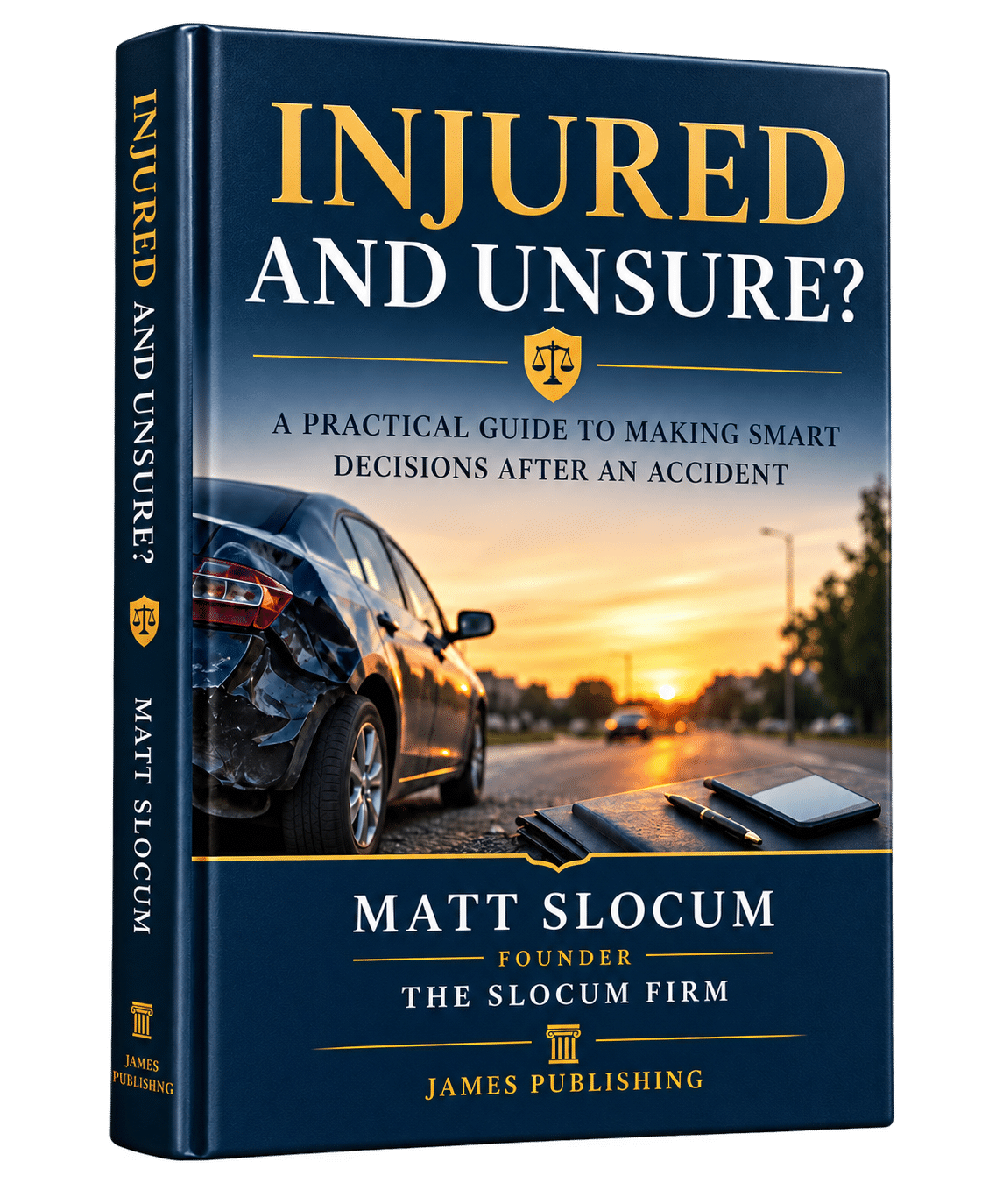
Download Your FREE Copy of Injured and Unsure? A Practical Guide to Making Smart Decisions After an Accident
If you've been injured because someone else was careless, you probably have questions—and you need answers you can trust. That's why I wrote Injured and Unsure? This practical, easy-to-understand guide explains what to do after an accident, how the insurance process works, and the mistakes that can cost you physically and financially.
Whether you're just beginning your recovery or trying to decide what to do next, I hope this book gives you the knowledge and confidence to make informed decisions every step of the way.
Download your free copy today. Then explore the videos, FAQs, and book excerpts below for even more practical guidance.
Practical Advice
Practical Advice from a Lawyer Who Has Helped Injury Victims for Years
After an accident, good information can be hard to find. Friends and family mean well, but they often don't know the answers. Insurance companies have their own priorities. And the internet is filled with conflicting advice that can leave you feeling even more uncertain.
For years, I've helped people throughout Pennsylvania navigate the physical, financial, and legal challenges that follow serious accidents. I've seen firsthand how a single decision—whether it's delaying medical treatment, giving a recorded statement too soon, or accepting an early settlement offer—can affect someone's recovery and their future.
That's why I believe education is one of the most important things I can provide. An informed person is better equipped to protect their health, avoid costly mistakes, and make confident decisions throughout the claims process.
I wrote Injured and Unsure? A Practical Guide to Making Smart Decisions After an Accident to answer the questions I hear every day from accident victims and their families. On this page, you'll find educational videos, practical FAQs, and other resources designed to help you better understand your rights and your options.
Whether you ultimately hire a lawyer or handle your claim on your own, my hope is that the information here helps you make smart decisions when they matter most.
Start Learning
Start Where You Are
Every accident is different, and so is every person's journey to recovery. That's why I've created a variety of resources to help you find the answers you're looking for—whether you have five minutes or an hour. Choose the format that works best for you.
Explainer Videos
Watch Matt break down the most important decisions you will face after an accident — in plain language, no legal jargon.
Frequently Asked Questions
Real answers to the questions injury victims ask most, drawn from Matt's years guiding Pennsylvania families through the process.
Book Excerpts
Read selected passages from Injured and Unsure? and get a free sample of the guidance inside the full guide.
Explainer Videos
Watch the Explainer Videos
Prefer to watch instead of read? These short videos cover some of the most important topics every accident victim should understand—what to do after an accident, dealing with insurance companies, protecting your health, and understanding the value of a claim.
The First 72 Hours After an Accident: The Decisions That Can Make or Break Your Case
The six most important steps to take after an accident so you can protect your health, preserve important evidence, and avoid mistakes that could affect your claim.
Why the Insurance Company Calls So Fast (And What They're Really Trying to Accomplish)
Why adjusters move so quickly, what they're trying to accomplish, and how you can protect yourself while still cooperating with the claims process.
"I Feel Fine." Why Some Accident Injuries Don't Show Up Right Away
Why delayed symptoms are so common, what warning signs to watch for, and why seeking prompt medical care is one of the smartest decisions you can make for your health and future.
What Is My Personal Injury Case Worth?
What really determines the value of a personal injury claim, why online settlement calculators are often misleading, and why it's usually too early to put a dollar value on your case immediately after an accident.
FAQs
Browse the Frequently Asked Questions
Explore answers to the questions accident victims ask most often. Each FAQ provides practical guidance to help you better understand your rights, avoid common mistakes, and make informed decisions throughout the claims process.
Immediately After the Accident
What Should I Do Immediately After a Car Accident?
Your first priority is safety. Move your vehicle out of traffic if you can, check for injuries, and call 911 if anyone is hurt or the damage is significant.
Exchange information with the other driver (name, contact, insurance, license plate) and get contact details from any witnesses. If you're able, take photos of the vehicles, the scene, and any visible injuries before anything is moved.
Be careful what you say. Avoid statements like "I'm sorry" or "this was my fault" — you don't have enough information yet to know what happened. Get checked out by a doctor even if you feel fine, since many injuries don't show symptoms right away, and notify your insurance company with the facts, not speculation.
You don't have to solve everything the same day. Focus on your health, preserve what evidence you can, and take it one step at a time.
Should I Call the Police After a Car Accident?
In most cases, yes — especially if anyone is injured or there's significant damage. A police officer creates an independent record of the scene, the parties involved, and any witness statements while everything is still fresh.
Even if the damage looks minor, situations can get more complicated once injuries surface or insurance companies get involved. A police report doesn't decide fault, but it gives everyone an objective account to refer back to.
If police don't respond, check whether your state requires you to report the accident yourself. When in doubt, it's better to have a report on file than to wish you did later.
Should I Go to the Emergency Room Even If I Feel Okay?
If you have severe pain, trouble breathing, heavy bleeding, numbness, or any other serious symptom, go to the ER or call 911 right away.
If you feel fine, be cautious anyway. Adrenaline can mask pain for hours or even days, and it's common to wake up the next morning with neck pain, stiffness, or headaches that weren't there before. Getting evaluated promptly — at an ER, urgent care, or your primary doctor — protects your health and creates a medical record connecting your injuries to the accident.
Don't worry about "wasting time" if it turns out you're fine. It's always better to confirm that than to ignore symptoms that get worse later.
What If My Pain Didn't Start Until a Day or Two After the Accident?
This is extremely common. Soft tissue injuries, whiplash, and even some head injuries often don't hurt right away — adrenaline masks pain at the scene, and symptoms build as inflammation sets in over the following days.
If pain develops after the fact, don't ignore it. Schedule a medical evaluation and tell your provider exactly when the accident happened and when your symptoms started. Waiting too long to seek care can give an insurance company reason to question whether the accident caused your injuries.
Delayed symptoms don't mean you don't have a claim. They just mean you should get checked out as soon as you notice them.
What Information Should I Collect at the Accident Scene?
If you're able, exchange names, phone numbers, addresses, driver's license numbers, license plates, and insurance information with the other driver. Get contact information from any witnesses too.
Take photos and video of the vehicles, damage, road conditions, skid marks, traffic signs, and any visible injuries — both close-up and wide shots. Write down what you remember (where you were headed, weather, traffic) while it's still fresh.
You're not trying to prove fault at the scene — just preserve the facts while they're available.
Should I Take Photos and Videos After an Accident?
Yes, if you're able and it's safe to do so. Evidence at the scene disappears quickly — vehicles get moved, skid marks fade, weather changes.
Photograph all vehicles from multiple angles, along with license plates, road conditions, and anything that may have contributed to the accident. If you have visible injuries, photograph those too — bruising and swelling can change fast. A short video walk-around can also capture context that photos miss.
If you can't do it yourself, ask a friend, family member, or bystander to help. You may never need the photos, but you'll be glad to have them if questions come up later.
What Should I Say — and Not Say — to the Other Driver?
Keep it simple: be polite, exchange the necessary information, and don't discuss fault.
Many people apologize instinctively after an accident, but comments like "I'm sorry" or "I didn't see you" can later be taken as an admission you didn't intend. You likely don't know yet exactly what happened, so there's no reason to guess out loud.
If the other driver wants to argue about who's at fault, don't engage. Let the police, insurance companies, and if necessary, the legal process sort that out based on the evidence.
What If the Accident Was Partly My Fault?
You may still be able to recover compensation. Many states, including Pennsylvania, recognize that more than one driver can share responsibility for an accident — the question isn't whether you were perfect, but how much responsibility each side bears.
This is one reason it's important not to admit fault at the scene. Determining responsibility takes a careful look at the evidence, and what seems obvious in the moment can look different once all the facts are known.
If you think you contributed to the accident, don't assume you have no case — but don't downplay or exaggerate your role either. Be honest, and talk to an attorney about how shared fault might affect your claim.
What Mistakes Can Ruin a Personal Injury Claim?
Most claims aren't lost to one big mistake — they're weakened by a series of small ones. The most common: waiting too long to see a doctor, skipping appointments or ignoring medical advice, and giving recorded statements or making casual comments ("I'm fine") before you know the extent of your injuries.
Social media is another trap. An innocent photo from a family event can be taken out of context by an insurance company as "proof" you're not really hurt. And accepting the first settlement offer before you understand your full recovery can leave you without money for treatment you'll need later.
The good news: all of these are avoidable. Get prompt care, follow your doctor's advice, document your recovery, and take your time with big decisions.
Should I Post About My Accident on Social Media?
The safest answer is no. Insurance companies routinely review claimants' public social media, looking for anything that seems inconsistent with the injuries being claimed — even an innocent photo or comment can be misread out of context.
You don't need to disappear from social media entirely, but avoid posting about the accident, your injuries, settlement talks, or conversations with your lawyer. A good rule of thumb: if you wouldn't want an adjuster or a jury reading it, don't post it.
Medical Care & Injuries
How Soon Should I See a Doctor After an Accident?
As soon as reasonably possible — even if you don't feel seriously hurt. Adrenaline can mask symptoms for hours or days, so an early evaluation both protects your health and creates a medical record connecting your injuries to the accident from the start.
Where you go depends on how serious things seem: emergency care for anything severe, urgent care or your primary doctor for everything else. The key isn't the specific place — it's not ignoring symptoms and assuming they'll go away.
If you didn't get checked out right away for a legitimate reason, that's not the end of the world. But going forward, don't try to diagnose yourself — let a professional make that call.
Why Do Some Injuries Show Up Days Later?
Adrenaline released during and after a traumatic event temporarily blocks pain. As those chemicals wear off and inflammation sets in, muscles tighten, soft tissue gets sore, and bruising appears — which is why whiplash, strains, and some concussions often aren't noticeable until a day or two later.
If new symptoms appear after an accident, don't brush them off just because they weren't there at the scene. See a doctor, especially if you notice headaches, dizziness, numbness, or trouble concentrating. Delayed symptoms are common — delayed treatment doesn't have to be.
What If My X-Rays or MRI Are Normal, But I'm Still in Pain?
Not every injury shows up on imaging. X-rays reveal broken bones but not soft tissue damage, and even MRIs miss some sources of pain. Many common accident injuries — whiplash, muscle strains, ligament injuries — are diagnosed based on your symptoms and how your body responds over time, not a single scan.
A "normal" result doesn't mean your pain isn't real. Keep communicating honestly with your providers about what hurts, what makes it worse, and how it's affecting your daily life.
What Are the Most Common Injuries After a Car Accident?
Whiplash is one of the most frequent — a neck injury from the sudden back-and-forth motion of a collision that can cause pain, stiffness, and headaches, often not appearing until hours or days later. Back injuries, soft tissue injuries, and concussions are also common, along with shoulder and knee injuries, wrist fractures, broken ribs, and cuts from airbags or broken glass.
Even low-speed collisions can cause real injuries, so don't assume you're fine just because the vehicle damage looks minor. If you feel pain or new symptoms, get evaluated and follow your provider's recommendations — your health, not your car's appearance, should guide what happens next.
How Important Are My Medical Records?
Very. Your medical records tell the story of your recovery — when you sought treatment, what you reported, what was diagnosed, and how things progressed. They're one of the most important pieces of evidence in any claim.
Be honest and thorough with every provider you see: mention all your symptoms, even minor ones, and follow your treatment plan as closely as you can. Gaps in care don't automatically hurt your claim, but they can raise questions later.
The best approach is simple: focus on getting better, be honest with your doctors, and follow their advice. Good medical care naturally creates good documentation.
What Happens If I Miss Doctor's Appointments?
An occasional missed appointment, rescheduled for a good reason, generally isn't a problem. But repeated gaps in treatment can hurt both your recovery and your claim — medically, because consistent care lets your doctor track your progress; legally, because insurance companies often use treatment gaps to question how serious your injuries really are.
If your treatment isn't helping, talk to your doctor about it rather than just stopping. Staying engaged in your recovery is the best thing you can do for both your health and your case.
Can I Recover Compensation If I Had a Pre-Existing Injury?
Yes. Having an old injury or condition doesn't disqualify your claim. The law generally holds that someone who causes an accident is responsible not just for new injuries, but for making an existing condition worse.
The key is separating what was pre-existing from what the accident caused or aggravated, which is where your medical history and your doctors' opinions come in. Never try to hide a prior injury — insurance companies almost always find out, and it can seriously hurt your credibility. Be upfront about your history and let the facts speak for themselves.
Should I Keep a Journal About My Symptoms?
Yes — a few brief notes are usually enough. Track your pain levels, new symptoms, appointments, medications, and how your injuries affect everyday life, like missing your daughter's soccer game because your back was hurting.
These small details paint a much clearer picture than trying to remember everything months later, and they're useful both at doctor's appointments and if your case eventually involves negotiation or litigation. Be honest — don't exaggerate. Think of it as a tool to help you remember what you've actually experienced.
Insurance Questions
Should I Talk to the Other Driver's Insurance Company?
Expect them to call soon after the accident — that's normal. Be polite and truthful, but you're not required to guess or speculate about anything you're not sure of, including the extent of your injuries.
It's fine to tell the adjuster you're still being treated and don't yet know how your recovery will go. Be cautious if they push you to estimate injuries, discuss fault, or sign anything before you understand what it means. This isn't a race — take the time you need.
Should I Give a Recorded Statement to an Insurance Adjuster?
You are not legally obligated to give a recorded statement to the other driver's insurance company. And doing so is risky. The insurance company may later use innocent remarks in your statement to question your claim.
It's best to decline to give a statement until you have received legal advice. If you have a lawyer, rely on them to communicate with the insurance company on your behalf.
There is one exception: if you have medical benefits on your own auto policy, you may be required under that policy to cooperate and provide some background information about the event to open the claim.
Why Is the Insurance Company Calling Me So Quickly?
Because they want to begin investigating while the accident is still fresh — gathering facts, identifying witnesses, and starting to evaluate the claim. That's normal, and it doesn't mean the adjuster is against you.
But remember your priorities are different: yours is recovering and making informed decisions; theirs is investigating and deciding what the company believes it owes. Since you may not yet know the full extent of your injuries, avoid guessing or making statements that could turn out to be inaccurate.
Why Did the Insurance Company Offer Me Money Right Away?
Before accepting any early offer, ask yourself: do I really know how badly I'm hurt? Often the answer is no — some injuries take days or weeks to fully show up, and once you accept a settlement and sign a release, your claim is generally over for good, even if your condition worsens later.
Some minor injuries do resolve quickly, and an early settlement can make sense in those cases. But make sure the decision is informed, not rushed. Settling too early is a bit like selling your house before an appraisal — you might get a fair price, or you might give up something worth a lot more.
How Do Insurance Companies Decide What My Claim Is Worth?
There's no set formula. Insurers weigh liability (how clear is fault), the nature and extent of your injuries, your financial losses (medical bills, lost wages, future care), how your injuries affect your daily life, the available insurance coverage, and the overall strength of the evidence.
Because every case involves a different mix of these factors, it's impossible to estimate a claim's value based only on the type of accident or the vehicle damage. A fair evaluation takes time and develops as more information — especially about your medical recovery — becomes available.
What If the Insurance Company Says My Injuries Aren't Serious?
An insurance company's opinion isn't a medical diagnosis. Early on, they may be working with incomplete information, and some injuries — soft tissue damage, concussions, chronic pain — are harder to evaluate than a visible broken bone.
Rather than arguing with the adjuster, focus on your recovery: follow your doctor's advice, attend appointments, and report your symptoms honestly. As your medical picture becomes clearer, the evidence supporting your claim typically does too.
What If the Other Driver Doesn't Have Insurance?
You may still have options. Start with your own policy — many drivers carry uninsured motorist (UM) coverage, which protects you when the at-fault driver has none, and underinsured motorist (UIM) coverage, which applies when their insurance isn't enough to cover your losses.
Depending on the situation, other parties may also share responsibility. And keep in mind that a UM claim against your own insurer still gets investigated like any other claim — it's not an automatic payout. Don't assume you have no options just because the other driver was uninsured.
Should I Use My Own Health Insurance After an Accident?
Yes, in most cases. Waiting for the other driver's insurance to pay your medical bills isn't realistic — liability has to be investigated first, which often takes weeks or months, and your health can't wait that long.
Using your own health insurance to get treatment generally does not hurt your personal injury case — in fact, prompt care usually strengthens it by documenting your injuries early. Depending on your plan and state law, your health insurer may later be entitled to reimbursement from any settlement, but that shouldn't stop you from getting the care you need now.
Do I Have a Case?
How Do I Know If I Have a Personal Injury Case?
It usually comes down to two questions: Was someone else negligent, and were you injured because of it? If yes to both, you may have a valid claim — though details like disputed fault, minor vehicle damage, or a delayed doctor visit can affect how it's evaluated without necessarily ruling it out.
You don't need to already know the answers before talking to a lawyer — that conversation is often how people find out where they stand. If you're unsure, get information rather than guessing.
What Does Negligence Actually Mean?
Negligence simply means someone failed to use reasonable care, and that failure caused someone else to get hurt — a driver running a red light, a property owner ignoring a known hazard, and so on.
It's not the same as an honest mistake, and not every accident means someone was negligent. Proving it usually requires evidence: witness statements, photos, police reports, medical records, and sometimes expert opinions. The law doesn't demand perfection — just reasonable care.
Can I Still Have a Case If There Were No Witnesses?
Yes. Witnesses are only one type of evidence — liability is often established through photographs, vehicle damage, police reports, surveillance footage, or medical records instead. The absence of witnesses doesn't make your case weak; it just means it may lean more heavily on other evidence.
This is exactly why it's important to preserve information right after an accident — photos, prompt medical care, and a written record of what happened all matter even more when there's no one else to back up your account.
Can I Still Recover Compensation If There Wasn't a Police Report?
Yes. A police report is often helpful, but it's not required. If none exists, other evidence — photos, medical records, repair estimates, witness statements, or your own written recollection — becomes more important.
Focus on preserving whatever evidence you do have. A claim is built on the totality of the evidence, not any single document, so a missing police report may create extra work but doesn't automatically prevent you from recovering compensation.
Can I Sue If I Slipped and Fell on Someone Else's Property?
Maybe. Property owners have to keep their premises reasonably safe, but that doesn't mean they're responsible for every fall. The key question is whether they knew (or should have known) about a hazard and failed to fix it — a spill sitting in an aisle for an hour is different from one that happened seconds before you walked by.
If you're injured in a fall, report it immediately, photograph the area if you can, get witness contact info, and see a doctor. The facts surrounding the fall — not the fall itself — determine whether you have a claim.
How Long Do I Have to File a Personal Injury Claim in Pennsylvania?
Generally two years from the date of injury — this is called the statute of limitations. Miss it, and you typically lose the right to sue entirely.
Two years sounds like a long time, but evidence disappears, witnesses move, and surveillance video gets erased within days or weeks. Some situations — claims against government entities, cases involving minors, wrongful death — have different, often shorter deadlines. It's best to learn your applicable deadline early rather than waiting until it's almost too late.
Money & Case Value
What Is My Personal Injury Case Worth?
Honestly, it's usually impossible to say right after an accident. Value depends on the severity of your injuries, your medical expenses, lost wages, future treatment needs, how clear liability is, and the insurance coverage available — and it only becomes clear as your medical picture develops.
The better approach is to focus first on your recovery. Once your doctors understand the full extent of your injuries, it becomes much easier to evaluate the true impact the accident has had on your life.
How Is Pain and Suffering Calculated?
There's no formula. Unlike medical bills, pain and suffering doesn't come with receipts — it's evaluated by looking at how your injuries have actually affected your life: how severe they were, how long recovery took, whether they're permanent, and how your daily activities and relationships have changed.
This is why online settlement calculators are unreliable — they can't capture the personal impact of an injury. The best evidence usually comes from consistent medical records and honest documentation of how your life has changed, not a price tag.
What Damages Can I Recover After an Accident?
Two broad categories. Economic damages are the financial losses you can document — medical bills, lost wages, reduced earning capacity, and other out-of-pocket costs. Non-economic damages cover harder-to-measure losses like physical pain, emotional distress, and loss of enjoyment of life.
Depending on your situation, future losses — ongoing treatment or long-term effects on your ability to work — may also be part of the claim. Because every injury and every recovery is different, claims aren't valued by simply adding up bills; the goal is understanding the accident's full impact on your health, finances, and quality of life.
Who Pays My Medical Bills While My Case Is Pending?
Personal injury cases can take months to resolve, and medical bills don't wait. Your own health insurance is usually the best starting point for covering treatment, and depending on your policy, your auto insurance may offer some medical benefits too.
Instead of requiring payment upfront, some medical providers will agree to wait and be paid later from your settlement or recovery.
Importantly, the other driver's insurance typically does not pay your bills as they come in — those costs usually become part of the overall claim, negotiated later. Don't delay treatment over payment concerns; ask questions early so you understand your coverage.
What If I Can't Work Because of My Injuries?
Follow your doctor's recommendations first — going back too soon can set your recovery back. Keep careful records of missed work: doctor's notes restricting activity, pay stubs, and any correspondence with your employer.
Lost wages are typically part of a personal injury claim, and if your injuries permanently affect your ability to work, reduced future earning capacity may be too. Most importantly, don't rush back to work just to protect your claim — that decision belongs to you and your doctor.
Should I Accept the Insurance Company's First Settlement Offer?
Sometimes it's fair — often it isn't, and immediately after an accident you usually don't have enough information to know the difference. Once you accept and sign a release, your case is generally closed for good, even if complications develop later.
Before accepting anything, ask yourself: Do I understand the full extent of my injuries? Has my doctor explained my long-term prognosis? Have I accounted for all my losses? If you're unsure on any of these, it's worth slowing down.
Can I Borrow Money Against My Settlement?
You may have seen ads for "lawsuit loans" or settlement advances. They can provide quick cash, but repayment is typically tied to your case's outcome — and the fees can make what you ultimately repay far more than what you borrowed.
Before signing anything, make sure you understand the full costs and how it could affect your final recovery. If you're facing financial hardship during your case, talk to your attorney first — there may be better options.
Hiring a Lawyer
Do I Really Need a Personal Injury Lawyer?
Not always. If your injuries were minor, you recovered quickly, and the insurance company is handling things fairly, you may be able to manage on your own.
Legal help becomes more valuable when injuries are significant or permanent, fault is disputed, your claim is denied, multiple parties may be responsible, or you're being pressured to settle before you've fully recovered. Rather than deciding based on fear or a commercial, learn about your rights and make an informed choice based on your own situation.
When Should I Call a Personal Injury Lawyer?
You don't need to wait until you're finished with medical treatment. Calling early can help you avoid mistakes that are hard to fix later, and it helps preserve evidence before witnesses become hard to find or surveillance video gets erased.
A consultation isn't a commitment — it's a chance to ask questions and understand your options. If your injuries are serious, fault is disputed, or you're just unsure what to do, there's rarely a downside to getting reliable information early.
How Much Does a Personal Injury Lawyer Cost?
Most personal injury attorneys work on contingency, meaning you generally don't pay upfront — the fee is a percentage of what's recovered, and if there's no recovery, there's typically no fee.
Before hiring anyone, make sure you understand exactly how the fee works: how it's calculated, what expenses you might owe, and how costs are handled if the case doesn't succeed. Don't let cost concerns stop you from at least having the conversation — it typically costs nothing to learn where you stand.
What Happens During a Free Consultation?
It's usually just a conversation. The attorney will ask what happened, what injuries you've suffered, what treatment you've had, and whether you've spoken with insurance companies. Bring what documents you have, but don't worry if it's incomplete.
You'll also get to ask your own questions about the process and what to expect. A good consultation should leave you with more clarity than you walked in with, and you should never feel pressured to hire anyone on the spot.
Can I Switch Lawyers If I'm Unhappy With My Current Attorney?
Yes. Clients generally have the right to change attorneys if they feel another lawyer is a better fit — whether communication has broken down or the case has grown more complicated than expected.
It's often worth having an honest conversation with your current attorney first, since many concerns can be resolved that way. If you do switch, your new attorney can typically handle the transition. The real question isn't whether changing lawyers will "hurt" your case — it's whether you have confidence in the person representing you.
The Claims Process
How Long Does a Personal Injury Case Usually Take?
It depends. Straightforward claims with minor injuries can settle in a few months; cases with serious injuries, disputed liability, or ongoing treatment can take much longer.
Your medical recovery is one of the biggest factors — settling before your doctors understand the full extent of your injuries can leave you without compensation for treatment you'll need later. Patience often produces a better outcome than rushing — the goal isn't finishing quickly, it's resolving the case fairly.
What Happens After I Hire a Lawyer?
Hiring a lawyer doesn't mean a lawsuit is filed right away. Your attorney's first job is to gather information — police reports, medical records, photographs, witness statements — while you focus on your recovery and keep them updated on any changes.
Much of a lawyer's work happens behind the scenes: negotiating with insurance companies, evaluating evidence, and monitoring your treatment. If a fair settlement can be reached, the case may end there. If not, your attorney will explain the next steps, which may include filing a lawsuit.
Will My Case Settle or Go to Trial?
Most personal injury cases settle rather than go to trial — despite what TV dramas suggest. Settlement lets both sides avoid the time, expense, and uncertainty of a trial.
That said, if there's a real dispute over fault or the value of your injuries, a lawsuit may become necessary. Ironically, preparing for trial often pushes both sides toward agreement, since it forces a clearer view of the case's strengths and weaknesses.
What Is a Deposition?
A deposition is part of the fact-gathering process before trial, where you answer questions under oath — usually in a conference room, not a courtroom, with attorneys from both sides and a court reporter present.
You'll be asked about the accident, your injuries, treatment, and how your life has been affected. Your attorney will prepare you beforehand. The advice is simple: tell the truth, listen carefully, answer only what's asked, and ask for clarification when you need it. Most clients find it far less stressful than they expected.
Will I Have to Testify in Court?
Probably not — most cases settle before trial, so many injured people never testify. If your case does go to trial, you may be asked to, but your job isn't to deliver a perfect speech. It's simply to tell the truth about what happened and how you've been affected.
Your attorney will prepare you beforehand so there are few surprises. Most people's anxiety comes from not knowing what to expect — once the process is explained, they feel much more comfortable.
What Can I Do to Help Strengthen My Case?
Focus on what's in your control: get appropriate medical care and follow your doctor's recommendations, be honest and consistent about your symptoms, and keep records of your treatment, expenses, and missed work. Save photos, receipts, and any accident-related correspondence, and avoid discussing your case on social media.
A strong claim is built through good medical care, accurate documentation, and thoughtful decisions over time — not overnight. You can't change that the accident happened, but the choices you make afterward can make a real difference in both your recovery and your claim.
Still have questions? Get answers in a free, no-obligation consultation.
Schedule a Free ConsultationFrom the Book
Inside Injured and Unsure?
Not sure if you want to read the entire book? Start with selected excerpts covering the topics that matter most—from medical treatment and insurance claims to settlement negotiations and protecting your legal rights.
After the Accident: The Moment Everything Changes
Why the first 24–72 hours after an accident can shape everything that comes next—and how adrenaline and confusion lead people to skip the steps that matter most.
Getting Medical Attention: Don't Wait
Why you should always get checked out, the danger of delayed symptoms, where to go, and how medical records begin telling your story from day one.
The Moment Insurance Enters the Picture
Why insurance companies reach out so quickly, what the friendly first call really is, and how to approach it thoughtfully.
Why Small Mistakes Matter More Than You Think
Most cases aren't lost to one big mistake—they're weakened by a series of small ones. The goal isn't perfection; it's awareness.
Waiting Too Long to Get Medical Care
Why delays create questions, how insurance companies view gaps, and why getting checked out sooner is always the better approach.
Case Value: The Question Everyone Wants Answered
Why it's so hard to answer "what is my case worth?" early on, why no two cases are the same, and a more realistic way to think about value.
Hiring a Lawyer: A Question Most People Ask Early
Do you really need a lawyer? Common assumptions, the self-assessment that helps you decide, and a practical way to think about it.
The Case Process and Timeline: Seeing the Big Picture
Why understanding the process reduces stress, the predictable path most cases follow, and the full case timeline at a glance.
Making Smart Decisions When It Matters Most
What it all comes down to—clarity, consistency, and patience. You can't change what happened, but you can control what happens next.
§1:01 Why the First 24–72 Hours Matter More Than You Think
If you've been in an accident, there's a good chance your first thought wasn't "What should I do to protect my legal rights?"
It was probably something like: "Am I okay?" "What just happened?" "I just want to get home." That's normal. It's exactly what I see with almost every client who walks into my office.
Here's the reality—and I say this after more than 25 years of handling injury cases: What you do in the first 24 to 72 hours after an accident can shape everything that comes next. It affects your health, your recovery, and your ability to prove what happened.
I'm not saying you need to become a lawyer in that moment. You don't. What I am saying is that a few simple decisions—made early—can make your life much easier down the road.
§1:02 The Confusion and Adrenaline After an Accident
Right after an accident, your body and your mind are not operating normally. Adrenaline is high. You may feel shaken, embarrassed, or even a little disoriented. In some cases, people feel completely fine—only to wake up the next day in real pain.
I've had countless clients tell me the same thing: "I didn't think it was a big deal at the time."
That's one of the biggest traps. When an incident feels minor, people tend to skip medical care, avoid making a report, and go home and try to move on. I get it. Most people don't want to make a scene. They don't want to overreact. Some even feel embarrassed—especially in situations like a fall in a store or a public place.
But here's the problem: The law—and insurance companies—don't see what you felt in that moment. They see what was documented. And if nothing is documented, your case becomes much harder later.
Real Scenario: "I Thought I Was Fine"
I see this all the time. Someone is in an accident. They get out, walk around, talk to the other driver. No ambulance. No obvious injuries. They go home thinking, "I'm okay." Two or three days later, they wake up in real pain. Now they're dealing with an injury—and trying to piece together what happened without any early documentation. That doesn't mean they don't have a case. But it does mean their case will probably be tougher to resolve than it could have been.
§1:03 How Early Decisions Can Affect Your Health and Your Case
If you take nothing else from this chapter, remember this: Medical care first. Documentation second. In that order. That's the framework I've used for decades, and it holds true in almost every case.
Your health comes first—always
You only get one body. I tell every client the same thing: Get better first. Everything else comes later. Even if you think you're okay, get checked out. Some injuries don't show up right away. Waiting can make things worse—not just medically, but in terms of proving what happened.
Documentation preserves your story
The second piece is documentation. Most accidents have one thing in common: they fade quickly. Skid marks disappear. Ice melts. Spills get cleaned up. Witnesses leave. Surveillance footage gets recorded over. And memory? That fades too. So when I say documentation, I mean creating a record that this actually happened—because later on, that record matters more than your memory alone.
In a perfect world, every case would be what I call a "clean case": police at the scene, photos taken immediately, medical treatment right away, records that line up from day one. On the other end of the spectrum, I see cases where none of that exists—no report, no photos, no early treatment—just someone coming in weeks later saying, "I got hurt."
Those cases aren't impossible—but they're harder. Much harder. If you follow a few simple steps early on—get medical care, report what happened, and document what you can—you put yourself in a much stronger position. And if you don't? You haven't lost your case. But you've made it more difficult than it needed to be.
Most people aren't thinking about a legal case in those first few hours—and they shouldn't be. But a few simple steps early on can make everything easier later.— Matt Slocum
§1:04 A Simple Way to Think About It
Over the years, I've boiled this down into something very simple: Take care of yourself. Then create a record. That's it. You don't need legal training. You don't need to know how insurance works yet. If you just do those two things in the first 24 to 72 hours, you're already ahead of most people.
§1:12 Why You Should Always Get Checked Out
If there's one piece of advice I could give every injured person—and I mean every single one—it's this: Go get checked out. Even if you think you're fine.
I've had this conversation thousands of times. Someone comes into my office and says, "I didn't go to the doctor because I didn't think I was hurt." A week later, they can't turn their neck. Their back is locking up. They're missing work. Now they're playing catch-up. Here's the truth: You are not in the best position to evaluate your own injuries right after an accident.
Your body is running on adrenaline. You're shaken up. You just want to move on. That's human nature. But injuries don't always announce themselves right away. When you wait, your condition can get worse, and it becomes harder to connect your injury back to the accident.
§1:13 The Danger of Delayed Symptoms
Some of the most common injuries I see—especially in car accidents—don't show up immediately. Neck pain, back pain, soft tissue injuries, even certain types of head injuries. You might feel fine at the scene, maybe even later that day. Then the next morning, everything tightens up. Or you start getting headaches. Or you realize something just isn't right.
This delay is exactly why people get into trouble. From a medical standpoint, early evaluation helps catch problems before they get worse. From a legal standpoint, timing matters—a lot.
When there's a gap—days or even weeks—between the accident and your first doctor visit, the natural question becomes: "What happened in between?" That question doesn't mean you don't have a case. It just makes things harder. Insurance companies look at timelines very closely, and one of the biggest red flags they look for is a delay in treatment. The longer the delay, the more room they have to argue that maybe you weren't really hurt, or that something else caused your injury. That's why I stress this so much. Early care protects both your health and your claim.
§1:14 Emergency Room vs. Urgent Care vs. Primary Doctor
People often ask me: "Where should I go?"
The answer depends on what's going on with you. If it's serious—severe pain, head injury, loss of consciousness, anything that feels urgent—go to the emergency room. Don't hesitate. If it's less severe, you still have options: urgent care centers, your primary care physician, walk-in clinics.
The specific location matters less than the fact that you're being evaluated by a medical professional. What I don't recommend is trying to "wait it out" for a few days to see if things improve. That's where people get into trouble.
And if you do go somewhere, make sure you tell them what happened: "I was in a car accident." "I slipped and fell." "I was bitten by a dog." That connection—between the event and your symptoms—needs to be in your medical record from the start.
§1:15 How Medical Records Begin Telling Your Story
Your medical records do more than document treatment. They tell the story of your injury. Think of it this way: if your case ever has to be evaluated—by an insurance adjuster, a lawyer, or even a jury—they're not there with you. They didn't feel what you felt. They rely on records.
Those records show when you first reported symptoms, what those symptoms were, how they progressed over time, and what treatment you needed. In many ways, medical records are the backbone of an injury case. Without them, you're asking someone to take your word for it. With them, you have a timeline that supports your experience.
§1:16 The Legal Risks of Delaying Treatment
Delaying treatment doesn't destroy your case—but it does make it harder. When there's no early medical record, we lose something important: no documentation of your condition right after the accident, no baseline for your injury, no immediate link between the event and your symptoms. Now we're trying to reconstruct everything after the fact.
Can it be done? Yes. I've done it many times. But it requires more work, more investigation, and sometimes more skepticism from the other side. On the flip side, when someone gets treatment right away, everything lines up: the accident happens, the person seeks care, the records reflect the injury. That's a clean, straightforward timeline. And in this area of law, clarity matters.
§1:17 Following Through Matters Just as Much
Getting that first visit is critical—but it's not the end of the story. You also need to follow your doctor's recommendations, attend follow-up appointments, and avoid unnecessary gaps in treatment.
Gaps in care raise the same kinds of questions as delays: "If you were hurt, why did you stop treatment?" Again, it doesn't mean your case disappears. It just gives the other side something to point to. So think of it as a continuation of the same principle: take care of yourself—and create a consistent record while you do it.
§1:18 What This Means for You
If you're unsure what to do after an accident, start here: get checked out, be honest about your symptoms, tell your provider how the injury happened, and follow through with care. You don't need to overcomplicate it.
I tell clients all the time: Your job is to get better. Everything else—legal strategy, insurance, negotiations—that comes later. But none of it works the way it should if you skip this step.
§4:01 When Insurance Gets Involved—and Why It Happens Quickly
After an accident, things can feel quiet at first. You go home. You're dealing with how you feel physically. Maybe you're trying to get back to your routine.
And then your phone rings. Or you get an email. Or a letter shows up. That's usually the moment people realize: Insurance is now part of this.
And for most people, it feels fast. Sometimes it's the same day. Sometimes the next day. Either way, it catches people off guard. They think, "That was quick."
There's a reason for that. Insurance companies move quickly at the beginning because this is when information is fresh, people are easier to reach, and the story hasn't fully developed yet. From their perspective, early contact is part of the process. From your perspective, it can feel like things are moving faster than you expected.
§4:02 Why You May Hear From Them So Soon
A lot of people assume that insurance companies wait until everything is figured out before reaching out. It's actually the opposite. They want to get involved early. Why?
Early on, details are still being formed, injuries may not be fully understood, and decisions haven't been made yet. This is when they can gather information, start evaluating the claim, and begin shaping how the case is viewed.
Again, this isn't personal. It's just how the system works. Insurance companies are designed to respond quickly when a claim is reported.
§4:03 The Friendly First Call: What It Really Is
When that first call comes in, it usually sounds something like this: "Hi, I'm calling from the insurance company. I just wanted to check in and see how you're doing."
The tone is polite. Professional. Sometimes even reassuring. But it's important to understand what that call really is. It's the beginning of their process.
They're not just checking in. They're gathering information, documenting what you say, and starting to evaluate the situation. They may ask what happened, how you're feeling, and whether you've seen a doctor.
It can feel like a casual conversation. But it's not casual. It's part of how the claim is built from their side.
§4:04 Why This Part of the Process Feels Confusing
This is where a lot of people start to feel unsure. On one hand the person on the phone is polite, the questions seem reasonable, and nothing feels confrontational.
On the other hand, you're not sure what you're supposed to say, you don't fully understand your injuries yet, and you haven't had time to think things through.
So you're caught in between. You want to be cooperative. But you don't want to say the wrong thing. That tension is completely normal.
What This Looks Like in Real Life
You get a call the day after the accident. The adjuster is polite. They ask how you're feeling and what happened. You answer honestly. It feels like a routine conversation. Later, you realize that call was the first step in documenting your claim—and everything you said became part of the record.
§4:05 A Better Way to Think About It
Here's how I explain this to clients: You're at the very beginning of a process that's already familiar to them—but brand new to you.
The insurance company handles claims every day. You don't. So there's naturally going to be a difference in experience, expectations, and pace. You need to approach this part of the process thoughtfully.
§4:06 What This Means for You
If you hear from an insurance company shortly after an accident, here's what I want you to keep in mind. It's normal for them to reach out quickly. The conversation may feel casual—but it has a purpose. You don't need to rush into anything. And you don't need to have all the answers right away.
Most importantly: You're allowed to take your time.
While this may be routine for them, for you, it's something new—and it's worth approaching carefully.
Insurance companies aren't the enemy—but they're not on your side either. They're following a process, and it helps to understand that.— Matt Slocum
§5:01 Most Mistakes Aren't Intentional
When I talk about "mistakes" in a personal injury case, I want to be very clear about something: Most people don't do anything wrong on purpose.
In fact, it's usually the opposite. People are trying to be honest and cooperative, handle things on their own, and get back to normal as quickly as possible.
These are all good instincts. The problem is that, in this process, some of these instincts can lead to unintended consequences—because you didn't realize how certain decisions would be viewed later.
§5:02 How Small Decisions Add Up Over Time
Most cases aren't affected by one big mistake. They're affected by a series of small ones.
Things like:
- Waiting a few days or weeks to see a doctor.
- Missing a follow-up appointment.
- Casually saying "I'm fine" when you're not.
- Giving more detail than necessary in an early conversation with the adjuster.
Each of those, on its own, may not seem like a big deal. But over time, they start to add up. And when your case is later evaluated, those small details create gaps, raise questions, or make things harder to explain.
§5:03 Why Early Missteps Can Affect the Entire Case
The early stages of a case are especially important. That's when your medical record begins, your version of events is first documented, and the insurance company starts forming its initial impression. So if something is missing, unclear, or inconsistent early on, it can carry forward throughout the process.
And once something is part of the record, we're often working to clarify it, explain it, or work around it, instead of starting from a clean, clear foundation.
§5:04 The Goal: Awareness, Not Perfection
Here's what I want to emphasize: You don't need to handle this perfectly.
That's not realistic, and it's not expected. The goal isn't perfection. It's awareness.
When you understand what matters, what can create problems, and how the process works, you're much less likely to run into avoidable issues. And if something does happen, you're in a better position to deal with it.
Real Scenario: "Nothing Major—At First"
A client told me they waited about a week to see a doctor because they thought it was just soreness. By the time they finally got checked out, the symptoms had gotten worse—and now we had to explain that gap. The case was still there. It just became more complicated than it needed to be.
§5:05 A Different Way to Think About It
Instead of thinking: "I need to do everything exactly right," a better way to think about it is: "I want to avoid the common mistakes that make things harder than they need to be."
That's it. Most of what we're going to talk about in this chapter is predictable, preventable, and something I see over and over again.
§5:06 What This Means for You
Most mistakes happen because people don't have the information. And a little awareness goes a long way. You don't need to overthink every step.
You just need to stay aware, stay consistent, and make thoughtful decisions. Because when you do that, you avoid the kinds of problems that can quietly cost you later.
Common Mistakes to Avoid
- Waiting too long to get medical care.
- Stopping treatment too early.
- Downplaying symptoms.
- Talking too freely with insurance adjusters.
- Posting carelessly on social media.
§5:07 Why Delays Raise Questions
One of the most common issues I see—and one of the easiest to avoid—is a delay in getting medical care.
After an accident, people often think: "Let me see how I feel in a few days." That's a completely natural reaction. You don't want to overreact. You don't want to rush to the doctor if it's nothing serious.
But here's the problem: Delays create questions. Not just medically—but legally. When there's a gap between the accident and your first treatment, someone reviewing the case is going to ask: "What happened during that time?"
§5:08 The Gap Between the Accident and Treatment
Let's say you wait a week before seeing a doctor. From your perspective, that might make perfect sense. You didn't feel pain right away. You thought it would go away. Life got busy.
But from the outside, that gap can look different. It can raise questions like: "Was the injury really caused by the accident?" "Did something else happen in between?" "If it was serious, why didn't you seek care sooner?"
These aren't accusations. They're the kinds of questions that come up when there's a delay.
§5:09 How Insurance Companies View Delays
From the insurance company's perspective, timing matters. They're looking for a clear connection between the accident and the injury.
When treatment happens quickly, that connection is easier to see. When there's a delay, that connection becomes harder to evaluate, easier to question, and sometimes easier to dispute.
§5:10 When a Delay Can Be Explained—and When It Becomes a Problem
Now, to be clear: A delay doesn't automatically ruin a case.
There are plenty of valid reasons why someone might not seek care right away. Symptoms didn't appear immediately. They thought it was minor. They tried to manage it on their own. These explanations can make sense.
But the longer the delay, the harder it becomes to connect everything cleanly. So what might start as "I just wanted to give it a few days" can turn into "Now we have to explain a gap in the timeline."
§5:11 A Better Way to Approach It
Instead of waiting and hoping things improve, a better approach is simple: Get checked out sooner rather than later.
That doesn't mean you need to assume the worst. It just means getting an evaluation, documenting how you feel, and creating a record early on.
Even if the injury turns out to be minor, you've taken care of your health and avoided unnecessary questions later.
§5:12 What This Means for You
If you've been in an accident, here's the takeaway: Don't ignore symptoms—even if they seem minor. Don't assume things will resolve on their own. And don't wait too long to get evaluated.
You don't need to panic. But you do want to be proactive. Because when it comes to both your health and your case, timing matters more than most people realize.
Mistake → Consequence → Better Approach
§7:01 "What Is My Case Worth?" — Why It's So Hard to Answer Early
This is usually one of the first questions people ask after an accident. It makes sense. You are dealing with medical bills, time away from work, and a lot of uncertainty, so you want to understand what all of this may lead to.
The problem is that this question does not have a simple answer, especially early on. At the beginning of a case, there are too many unknowns. Your medical condition may still be developing, the full extent of your treatment is unclear, and the facts surrounding the accident may still be under investigation.
Trying to put a number on a case too soon can create more confusion than clarity. A case is not a fixed number that exists from day one. It becomes clearer over time as the facts and the medical picture develop.
There's no advantage to putting a number on your case before you understand your injury.— Matt Slocum
§7:02 Why People Expect a Simple Number
Most people come into this process expecting that there is a formula. They assume there is a chart, a calculator, or some standard value for certain injuries. It is a reasonable assumption, especially if you have never been through this before.
Part of that expectation comes from what people hear from others. Friends, family members, or coworkers may share what their case was "worth," and it creates the impression that similar situations should lead to similar outcomes.
The reality is much different. Personal injury cases are highly fact-specific. Even cases that seem similar on the surface can turn out very differently once you look at the details.
§7:03 The Problem with Early Estimates
Early estimates can be misleading, even when they are well intentioned. If someone gives you a number too soon, it is often based on incomplete information. That number may go up, or it may go down, depending on how the case develops.
There is also a practical risk. If you anchor yourself to an early estimate, it can shape your expectations in a way that does not match reality later. That can lead to frustration or pressure to settle before you fully understand your situation.
A more careful approach is to focus on gathering information first. As your treatment progresses and more facts become clear, the range of potential value becomes easier to understand.
A big mistake I see is people locking into a number too early—before the real story of their injury is clear.— Matt Slocum
§7:04 Why No Two Cases Are the Same
No two cases are exactly alike, even when the injuries seem similar. One person may recover quickly, while another may deal with long-term pain. One case may have clear evidence of fault, while another involves disputes about what actually happened.
There are also differences in how injuries affect people's lives. The same physical injury can have a very different impact depending on a person's job, daily activities, and overall health.
Because of these differences, comparing one case to another is rarely helpful. Each case has to be evaluated on its own facts, its own medical history, and its own impact on the person involved.
§7:05 A More Realistic Way to Think About Value
A better way to think about case value is as a range rather than a fixed number. That range becomes clearer over time as key pieces of the case fall into place—your medical treatment, the strength of the evidence, and how your injuries affect your daily life.
It is also helpful to think of value as something that is built. The decisions you make after the accident, especially regarding medical care and documentation, play a role in how your case is viewed later.
This approach allows you to stay focused on what matters most in the early stages. Instead of chasing a number, you are putting yourself in a position to understand the true value of your case when the time is right.
Case value isn't something you guess at—it's something that becomes clear when the facts and the medical picture come together.— Matt Slocum
§7:06 What This Means for You
You do not need to know the exact value of your case right away. In fact, trying to pin it down too early can lead to poor decisions. What matters more is making consistent, informed choices as your situation unfolds.
Focus first on your health and your recovery. Make sure your injuries are properly evaluated and treated, and that your medical records accurately reflect what you are experiencing.
As the case develops, the picture becomes clearer. When the right time comes, you will be in a much better position to understand what your case is truly worth and to make a decision that protects your interests.
§9:01 Do You Really Need a Lawyer?
After an accident, this question comes up quickly. In many cases, it is one of the first decisions people start thinking about once the initial shock wears off.
Some people assume the answer is always yes. Others believe they should avoid hiring a lawyer unless things become complicated. Both approaches miss an important point.
The better question is not just whether you need a lawyer. It is whether having one would make a meaningful difference in your specific situation.
§9:02 Why This Question Comes Up So Quickly
There are a few reasons this question comes up early. Medical bills begin to arrive, insurance companies start contacting you, and there is often uncertainty about what to do next.
At the same time, you may feel pressure to make decisions quickly. Adjusters may ask for statements, or you may be presented with forms or settlement discussions sooner than expected.
All of this creates a sense that you need to decide right away. In reality, you have time to understand your options before making that decision.
You don't have to decide everything in the first few days—but some of the decisions you make early can matter later.— Matt Slocum
§9:03 Common Assumptions About Hiring a Lawyer
Many people come into this process with certain assumptions about lawyers. Some believe that hiring a lawyer will automatically lead to a larger recovery.
Others worry that it will make the process more complicated, take longer, or reduce what they ultimately receive because of fees.
There is some truth behind both perspectives, but neither tells the whole story. The impact of hiring a lawyer depends on the details of your case and how it is handled.
§9:04 When People Try to Handle Things on Their Own
It is very common for people to start handling a claim on their own. If the accident seems straightforward and the injuries appear manageable, that approach can feel reasonable.
In the early stages, things may go smoothly. You may be able to communicate with the insurance company and submit basic information without much difficulty.
The challenge is that cases often become more complex over time. What starts out simple can change as medical treatment continues or as questions about the claim arise.
§9:05 A More Practical Way to Think About the Decision
Instead of viewing this as a yes-or-no question, it can be helpful to think of it as a practical decision based on your circumstances.
Consider the seriousness of your injuries, the financial impact, and how comfortable you feel dealing with insurance companies and documentation. These factors tend to matter more than general assumptions.
This approach allows you to make a more informed choice. It also gives you flexibility if your situation changes as the case develops.
The question isn't 'Do I need a lawyer?' It's 'What happens if I don't have one in this situation?'— Matt Slocum
§9:06 What This Means for You
You do not have to rush into a decision about hiring a lawyer. Take the time to understand your situation and what is involved in handling a claim.
Pay attention to how your case develops. If things become more complex or uncertain, that may be a sign to reconsider your approach.
The goal is not to follow a rule. It is to make a decision that fits your situation and helps you move forward with confidence.
Do You Need a Lawyer? A Quick Self-Assessment
- Are your injuries more than minor or still ongoing?
- Have you missed work or expect future income loss?
- Is there any disagreement about who caused the accident?
- Are you unsure how to value your case?
- Do you feel uncomfortable dealing with the insurance company?
If you answered "yes" to one or more of these, it's worth at least speaking with a lawyer.
§10:01 Why Understanding the Process Reduces Stress
After an accident, most people feel like they've been dropped into a process they don't understand. There are phone calls, paperwork, medical appointments, and insurance issues, all happening at once. Without a clear picture of what lies ahead, it's easy to feel overwhelmed or unsure if things are moving the way they should.
Understanding the general path of a personal injury case helps bring a sense of order to what can otherwise feel chaotic. When you know what stage you are in and what typically comes next, you are better able to make decisions with confidence. It also helps you avoid unnecessary worry when things seem quiet or slow, which is often a normal part of the process.
Most of the stress comes from not knowing what's normal. Once you understand the process, a lot of that uncertainty goes away.— Matt Slocum
§10:02 The Reality: Most Cases Follow a Predictable Path
While every case is unique, most personal injury claims follow a fairly consistent sequence of steps. The case begins with the accident and medical treatment, moves into investigation and documentation, and often progresses through negotiation before ever reaching a lawsuit. If a lawsuit is filed, the case then follows a structured legal process that includes discovery, continued negotiations, and sometimes trial.
This structure exists for a reason. It allows both sides to gather information, evaluate the claim, and attempt to resolve the matter fairly. Even though the details may differ from case to case, the overall path is more predictable than most people expect.
§10:03 Why No Two Cases Are Exactly the Same
Even though the process follows a general pattern, no two cases move at the same speed or unfold in exactly the same way. The timeline can be affected by many factors, including the severity of injuries, how clear fault is, the amount of available insurance coverage, and how cooperative the parties are.
For example, a case involving minor injuries and clear liability may resolve relatively quickly. A case involving serious injuries, disputed fault, or multiple parties may take much longer. These differences do not mean something is wrong. They simply reflect the reality that each case has its own set of facts and challenges.
§10:04 A Simple Way to Think About the Timeline
A helpful way to think about a personal injury case is to break it into stages. First comes the immediate aftermath of the accident and your medical care. Next is the period of investigation and documentation, where the foundation of the case is built. After that comes negotiation, where efforts are made to resolve the case without filing a lawsuit.
If those efforts are not successful, the case may move into litigation, which includes formal steps like filing a lawsuit, exchanging information, and preparing for trial. At each stage, the goal is the same: to gather the information needed to fairly evaluate the claim and move toward a resolution.
The Personal Injury Case Timeline at a Glance
Every case is different, but most follow a similar path. This simple timeline shows how a typical case unfolds:
- Accident and Immediate CareMedical treatment begins, and the claim is reported.
- Investigation and Case BuildingEvidence is gathered, records are collected, and liability is evaluated.
- Medical Treatment and RecoveryYou continue treatment until your condition stabilizes.
- Demand and NegotiationYour case is presented to the insurance company and negotiations begin.
- Lawsuit (If Needed)A formal case is filed if a fair resolution cannot be reached.
- DiscoveryBoth sides exchange information and take depositions.
- Mediation and Further NegotiationSettlement discussions intensify as more facts become clear.
- Trial (If Necessary)A judge or jury decides the outcome.
§10:05 What This Means for You
You do not need to memorize every step or understand every legal detail to move through this process successfully. What matters is having a general sense of where you are and what to expect next.
It also helps you focus on what truly matters. Your health, your recovery, and the consistency of your actions will have a greater impact on your case than trying to control the pace of the process. When you understand the big picture, you are better equipped to navigate each stage with patience and confidence.
If you've made it this far, you already understand something many people don't: A personal injury case is not just about what happened in the accident. It's about what happens after the accident.
The decisions you make—often small, everyday decisions—shape everything that follows.
What This All Comes Down To
Throughout this book, we've covered a lot: why the first few days after an accident are so important, how injuries can develop and why they're often misunderstood, what it really means to "have a case," how insurance companies operate, the common mistakes that can quietly damage a claim, what actually builds a strong case, how value is determined, how to handle medical bills and financial pressure, and when hiring a lawyer makes sense.
But underneath all of that is a simple idea: This process rewards clarity, consistency, and patience—and punishes confusion, delay, and guesswork. You don't need to do everything perfectly. But you do need to be intentional.
The Position You're In
If you've been injured, you're in a position you didn't choose. You may be dealing with pain, bills, calls and pressure from insurance companies, and uncertainty about what comes next.
It's easy to feel like you're reacting to everything. This book is meant to help you shift from reacting… to understanding. From guessing… to making informed decisions.
What You Can Control
You can't control how the insurance company evaluates your claim or how long the process takes. But there are things you can control—and they matter more than you might think:
- Getting proper medical care and following through.
- Being honest and consistent about your symptoms.
- Keeping records and documenting what's happening.
- Being thoughtful about what you say and do.
- Getting the right guidance when you need it.
When you focus on these things, everything else becomes more manageable.
A Better Way to Move Forward
At this point, you don't need more information. You need a clear next step. For some people, that means continuing to handle things on their own with a better understanding of the process. For others, it means getting guidance to avoid mistakes and protect what matters most.
There's no one-size-fits-all answer. But there is a right answer for your situation.
A Conversation Can Change Everything
One of the most common things I hear from people is this: "I wish I had known this sooner." Not because they made a major mistake—but because they didn't realize how much the small decisions mattered.
Sometimes, a short conversation at the right time can clarify whether you even have a case, help you avoid costly missteps, and give you peace of mind about what to do next. Even if you decide not to hire a lawyer, you'll walk away with a clearer understanding of where you stand.
Your Next Step
If you're unsure about your situation, the best next step is simple: Have a conversation. Ask questions. Get clarity.
At The Slocum Firm, we take the time to listen, understand what you're dealing with, and give you straightforward guidance about your options—without pressure and without obligation. Whether your case is straightforward or complicated, the goal is the same: help you make smart decisions from this point forward.
Final Thought
You can't change what happened. But you can control what happens next. And that can make all the difference.
What You Will Learn
What You'll Learn
The hours and days after an accident can be confusing. You may be dealing with injuries, medical appointments, insurance adjusters, and questions you never expected to face.
Injured and Unsure? was written to help you make informed decisions during every stage of your recovery. Inside, you'll learn:
-
What to Do Immediately After an Accident
Discover the important steps to take in the hours and days following an accident to protect your health, preserve important evidence, and avoid common mistakes.
-
Why Your Medical Decisions Matter
Learn why some injuries don't appear right away, why prompt medical treatment is so important, and how your medical records can affect both your recovery and your claim.
-
How to Deal with Insurance Companies
Understand why insurance adjusters contact you so quickly, what to expect during the claims process, and how to avoid saying or doing something that could unintentionally hurt your case.
-
What Really Determines the Value of a Personal Injury Case
Get a clear explanation of the many factors that influence the value of a claim—including medical treatment, lost income, pain and suffering, insurance coverage, and more.
-
The Most Common Mistakes Accident Victims Make
Avoid the costly errors that can delay your recovery or weaken your claim, from waiting too long to seek medical care to accepting a settlement before you understand the full extent of your injuries.
-
When It Makes Sense to Talk with a Lawyer
Not every accident requires legal representation. Learn when you may be able to handle a claim on your own, when professional guidance can make a meaningful difference, and what to expect if you decide to seek legal advice.
Whether you read the book cover to cover or turn to the chapters that address your immediate concerns, you'll come away with a better understanding of your rights, your options, and the decisions that can shape your future after an accident.
Why Trust Matt
Why So Many Injury Victims Have Trusted Matt Slocum
Choosing a personal injury lawyer is an important decision. Beyond experience and credentials, you want someone who will listen to your concerns, answer your questions honestly, and help you make informed decisions during one of the most difficult times in your life.
For years, Matt Slocum has represented people throughout Pennsylvania who have been injured because of someone else's negligence. He understands that every client arrives with a different story, different concerns, and different goals. That's why he believes every client deserves straightforward advice, clear communication, and personal attention from beginning to end.
Matt's approach has always been simple:
- Put the client's health and recovery first.
- Explain the legal process in plain English.
- Keep clients informed every step of the way.
- Prepare every case carefully and thoroughly.
- Pursue the best possible outcome through skilled negotiation or litigation when necessary.
His commitment to educating accident victims extends well beyond the courtroom. In addition to representing clients, Matt has invested countless hours creating books, videos, articles, and other educational resources to help people understand their rights before they make important decisions.
The goal has never been simply to resolve cases.
It's to help people regain confidence after an accident by giving them the knowledge they need to move forward.
If you've been injured and aren't sure what to do next, you're not alone. Whether you begin by reading the book, watching the videos, exploring the FAQs, or scheduling a free consultation, Matt hopes these resources will help you make smart decisions for yourself and your family.
Google Reviews
Rated 4.95 / 5 on Google
Real words from real Pennsylvanians who trusted Matt Slocum with their case.
"After another law firm spent nearly a year reviewing my auto accident case only to tell me it was not worth pursuing. I contacted The Slocum Firm for a second opinion. I'm very glad I did. The team took my case seriously from the beginning and ultimately secured approximately $350,000 in total settlements, including successfully obtaining the full $100,000 available under my underinsured motorist coverage after my insurance company initially refused to pay it. They also negotiated a significant reduction in medical repayment claims, which made a meaningful difference financially. Like many personal injury cases, the process sometimes moved slowly, particularly while waiting on insurance companies and outside parties during negotiations. However, I always felt that the firm was working in my best interest and advocating for the best possible outcome. Overall, I had an extremely positive experience with The Slocum Firm and would absolutely recommend them to anyone looking for a knowledgeable and persistent personal injury firm."
P R
5-Star Google Review
"If you want a firm who truly fights for you and won't back down, The Slocum Firm is the one. After my car accident, I needed a team that would take my case seriously and make sure I wasn't taken advantage of and that's exactly what they did. They stayed on top of everything and handled my case with professionalism and strength. I never had to chase them down for answers. They made sure I understood every step and made it clear they were in my corner. Most importantly, they delivered. They fought to make sure I got what I deserved, and that means everything to me. I can't thank Matt, Michael, and everyone at The Slocum Firm enough. If you're looking for attorneys who stand firm, communicate clearly, and actually get result then this is the team you want representing you. 10/10!"
Tiffany Febus
5-Star Google Review
"The Slocum Firm consistently delivers exceptional service, as demonstrated by Matt and Michael's unwavering commitment to achieving positive results in my case. Based on my prior positive experiences with The Slocum Firm, I offer my strongest recommendation. They represent a team of dedicated legal professionals who prioritize client advocacy. For legal matters concerning injury, worker's compensation, or unemployment, engaging The Slocum Firm is highly recommended. I am confident that your experience will be equally satisfactory."
Miesha Holt
5-Star Google Review
"I was in an accident that changed my quality of life and I knew I needed to find a lawyer to help me through the process. I looked online and read reviews. That is how I found the Slocum law firm. I can honestly say that choosing them has been one of the best decisions I have ever made. It has been less than a year and my settlement has been resolved. They were able to get me the max that I could possibly get. I am most impressed with the work and support from the paralegal, Luz Garcia. She has been on top of everything from day 1. If I had any questions or concerns, she always addressed them quickly. I hope to never need to go through a situation like this again but if I ever do, the Slocum Law Firm will be the first call I make. I am truly grateful for everything they have done for me and for doing it as quickly as they did. If I could give more than 5 stars, I would for sure."
Tim Kane
5-Star Google Review
The Slocum Firm
The Slocum Firm
Since 2009, we've dedicated ourselves to helping injured victims across Pennsylvania, combining decades of experience with a relentless commitment to justice. With over 50 years of combined experience and millions recovered for our clients, The Slocum Firm is the trusted partner you need to take on even the most powerful opponents.
Get a free copy of Matt Slocum's book or schedule a confidential, no-obligation case review.
Or call us at 570-209-7376